

Topkapi Palace Museum
Architect: Mimar Sinan, Acem Ali, Sarkis Balyan, and Davud Aga
Sub-Style: Ottoman, Baroque
Year Completed: 1459 to late 17th C.
Size: 59,260 to 70,000 m2 (637,900 to 753,500 sq ft)
Location: Istanbul, Turkey

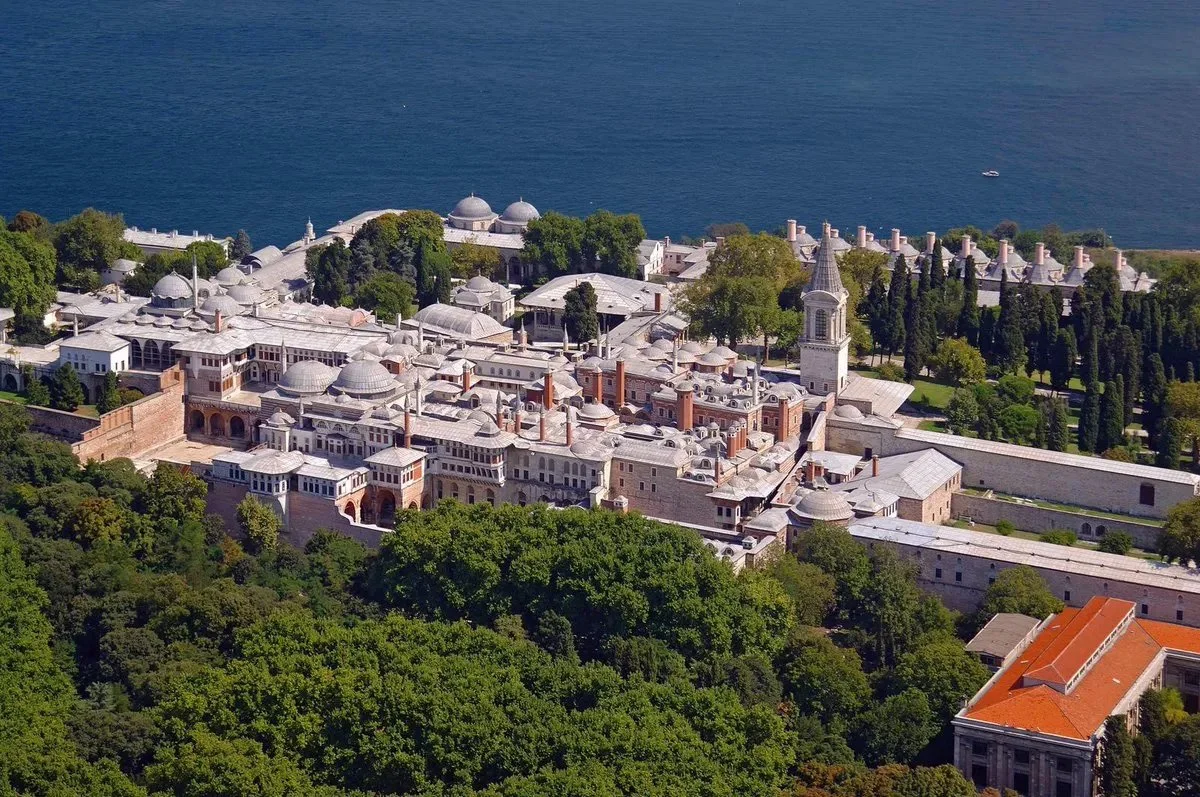
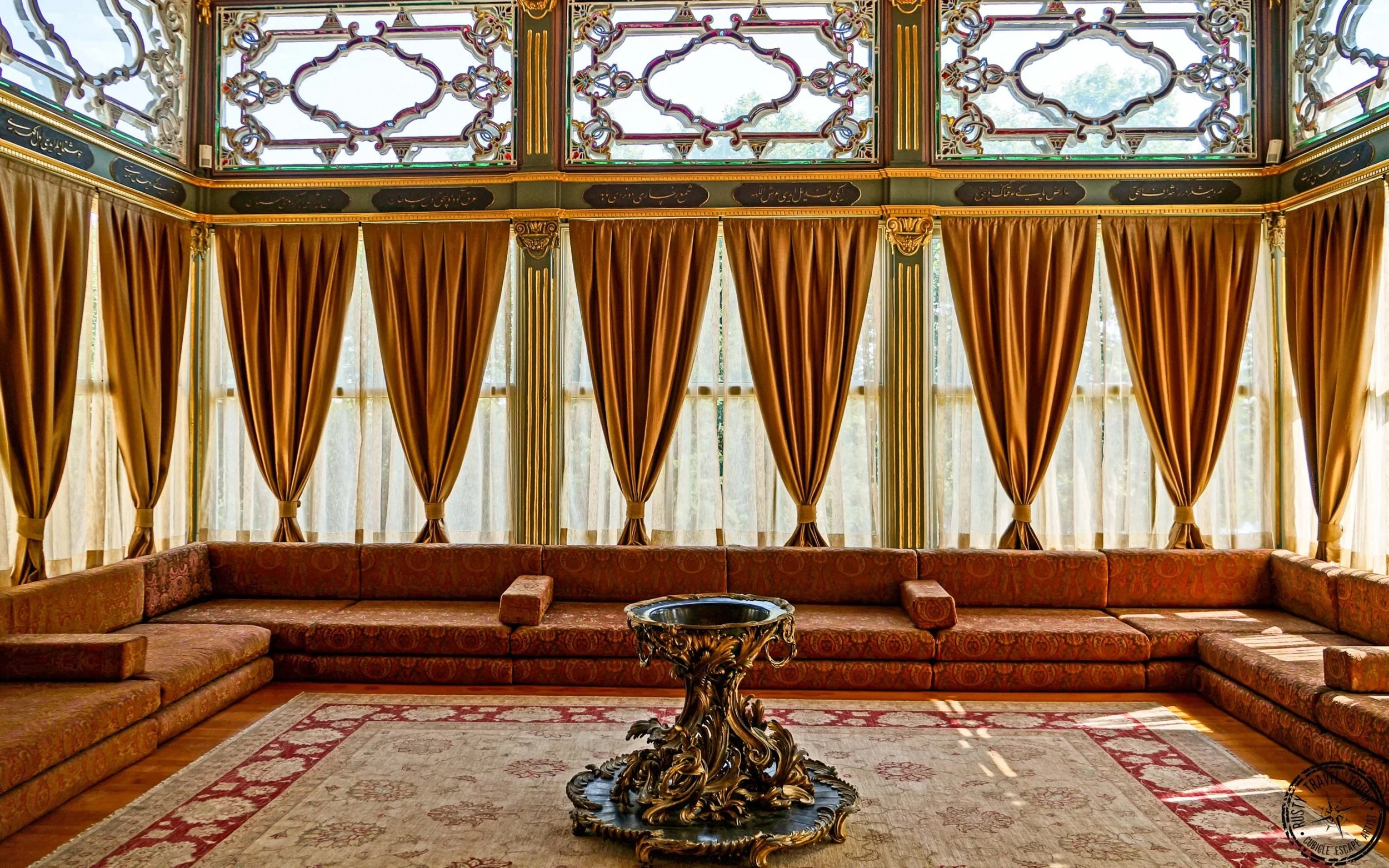
The Topkapı Palace, or the Seraglio, is a large museum and library in the east of the Fatih district of Istanbul in Turkey. From the 1460s to the completion of Dolmabahçe Palace in 1856, it served as the administrative center of the Ottoman Empire, and was the main residence of its sultans.
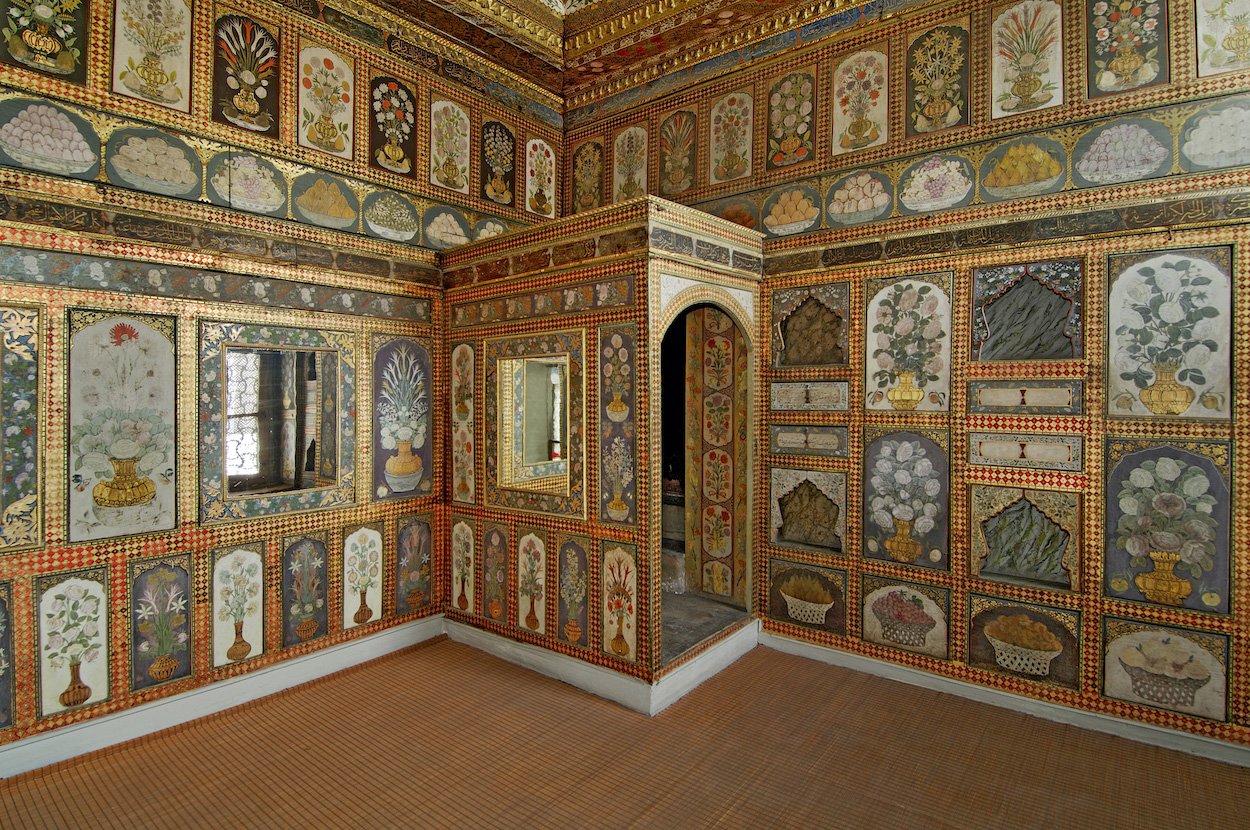
Construction, ordered by the Sultan Mehmed the Conqueror, began in 1459, six years after the conquest of Constantinople. Topkapı was originally called the "New Palace" (Yeni Saray or Saray-ı Cedîd-i Âmire) to distinguish it from the Old Palace (Eski Saray or Sarây-ı Atîk-i Âmire) in Beyazıt Square. It was given the name Topkapı, meaning Cannon Gate, in the 19th century. The complex expanded over the centuries, with major renovations after the 1509 earthquake and the 1665 fire. The palace complex consists of four main courtyards and many smaller buildings. Female members of the Sultan's family lived in the harem, and leading state officials, including the Grand Vizier, held meetings in the Imperial Council building.
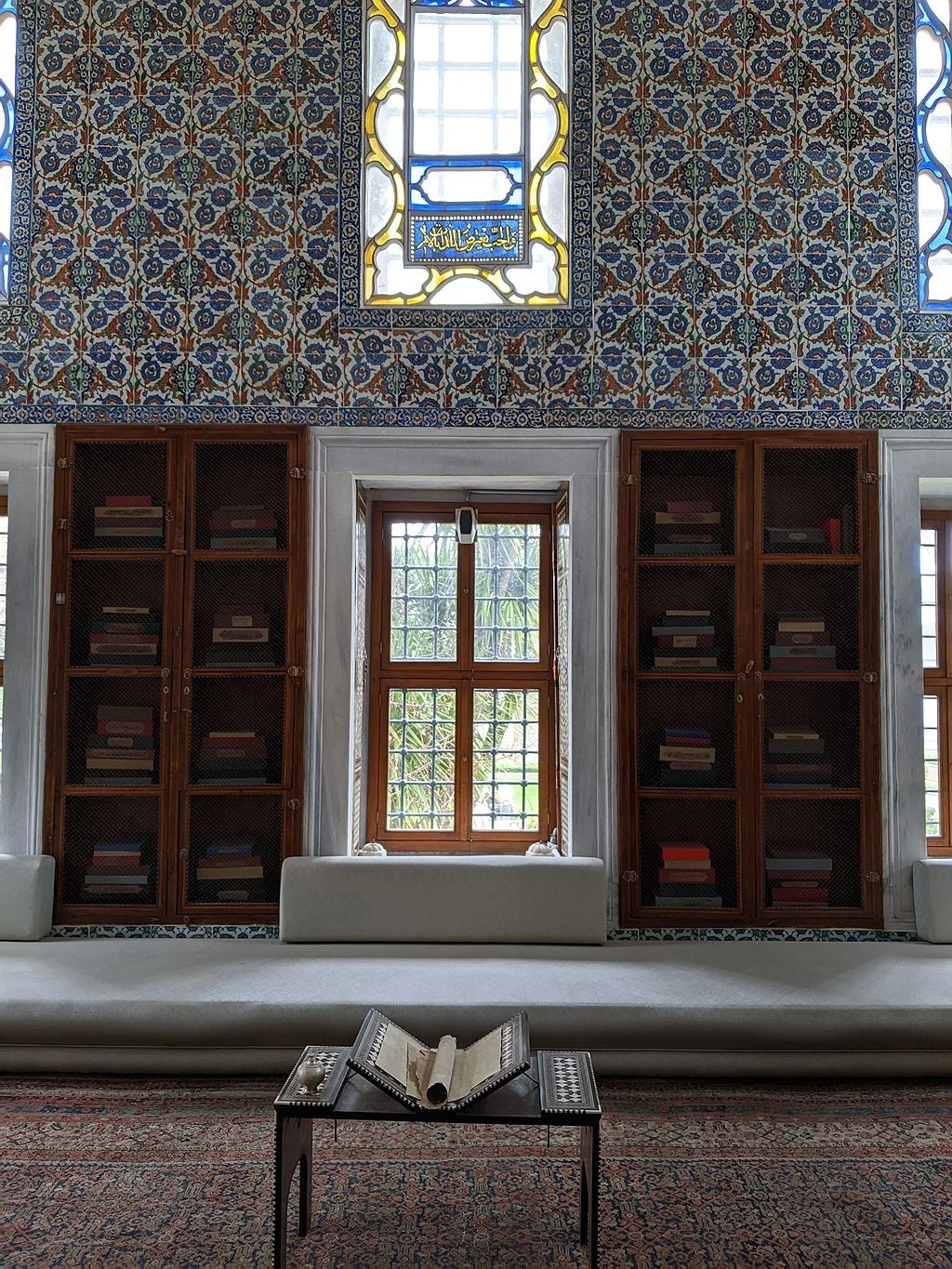
After the 17th century, Topkapı gradually lost its importance. The sultans of that period preferred to spend more time in their new palaces along the Bosphorus. In 1856 Sultan Abdulmejid I decided to move the court to the newly built Dolmabahçe Palace. Topkapı retained some of its functions, including the imperial treasury, library and mint.
-
After the end of the Ottoman Empire in 1923, a government decree dated April 3, 1924 transformed Topkapı into a museum. Turkey's Ministry of Culture and Tourism now administers the Topkapı Palace Museum. The palace complex has hundreds of rooms and chambers, but only the most important are accessible to the public as of 2020, including the Ottoman Imperial Harem and the treasury, called hazine where the Spoonmaker's Diamond and the Topkapi Dagger are on display. The museum collection also includes Ottoman clothing, weapons, armor, miniatures, religious relics, and illuminated manuscripts such as the Topkapi manuscript. Officials of the ministry as well as armed guards of the Turkish military guard the complex. The Topkapı Palace forms a part the Historic Areas of Istanbul, a group of sites in Istanbul that UNESCO recognised as a World Heritage Site in 1985.
History
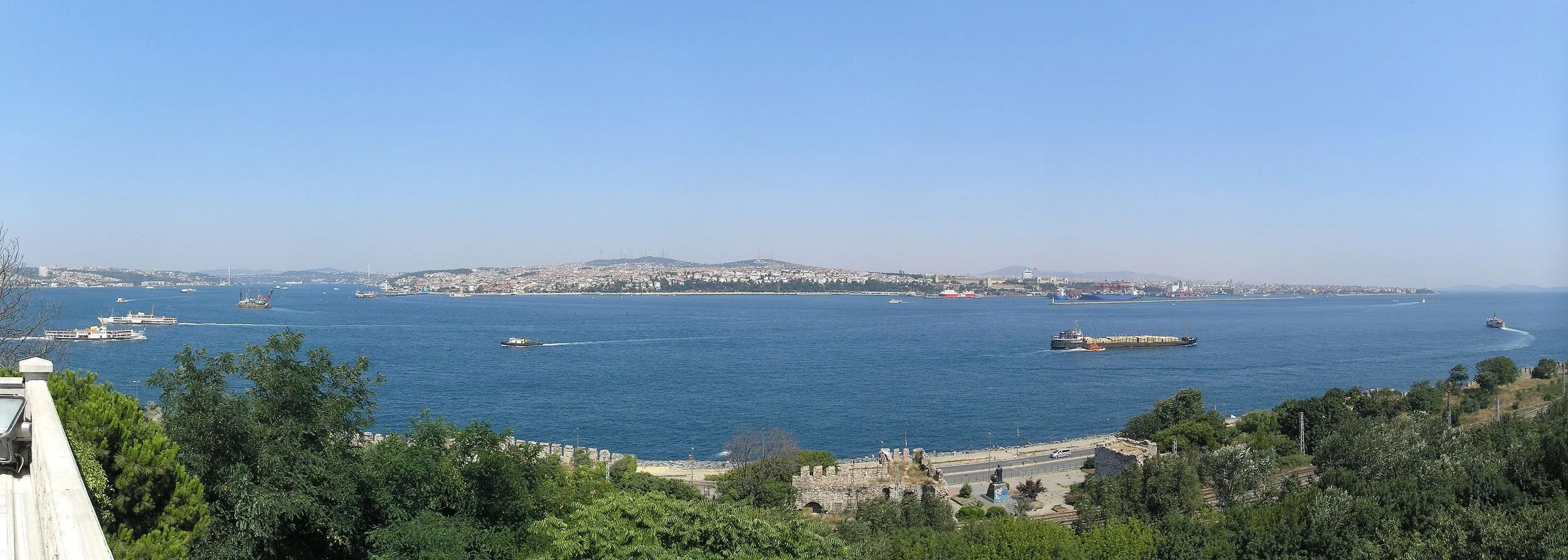
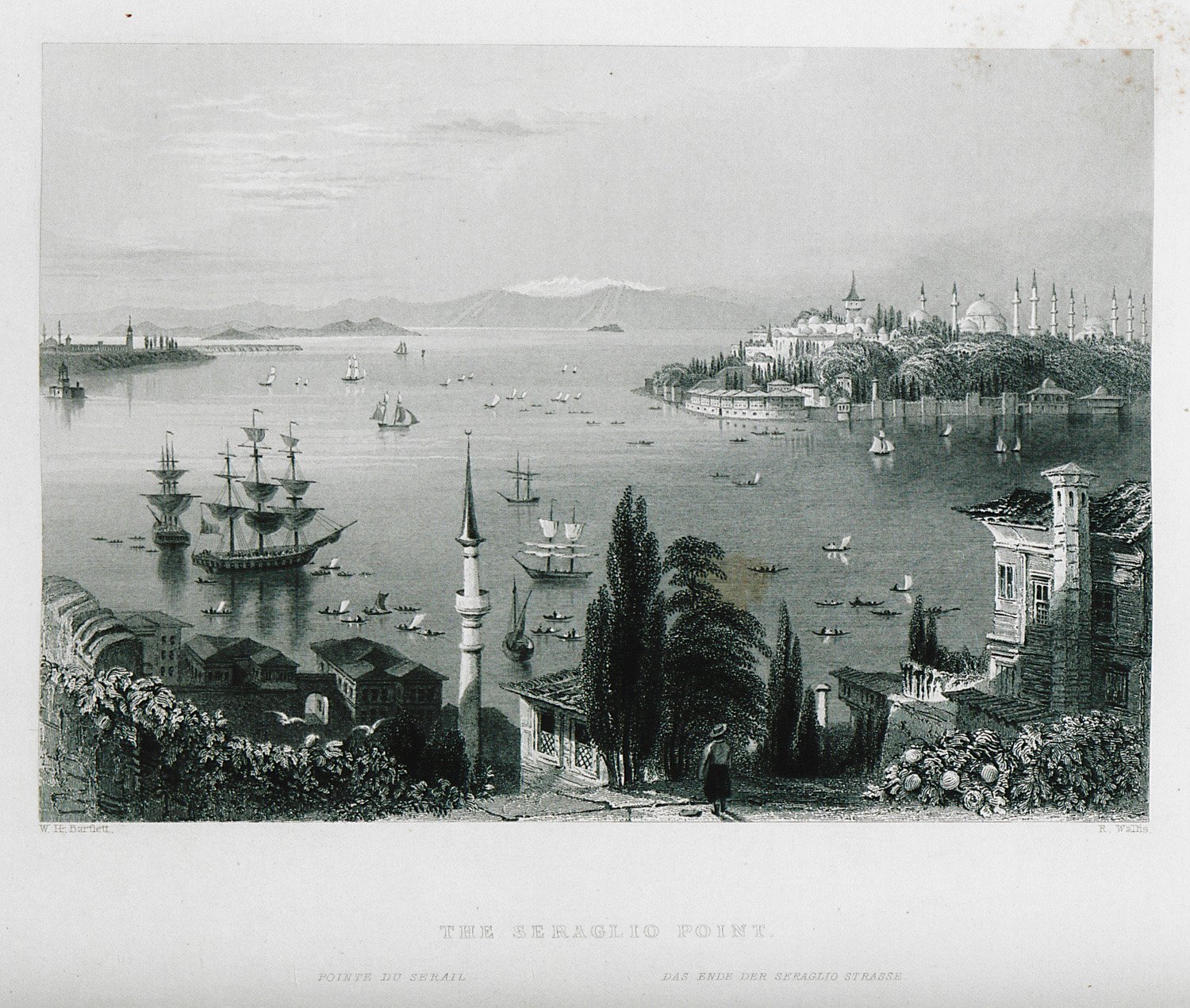
The palace complex is located on the Seraglio Point (Sarayburnu), a promontory overlooking the Golden Horn, where the Bosphorus Strait meets the Marmara Sea. The terrain is hilly and the palace itself is located at one of the highest points close to the sea. During Greek and Byzantine times, the acropolis of the ancient Greek city of Byzantion stood here.
After Sultan Mehmed II's conquest of Constantinople (known since 1930 in English as Istanbul) in 1453, the Great Palace of Constantinople was largely in ruins. The Ottoman court was initially set up in the Old Palace (Eski Saray), today the site of Istanbul University in Beyazit Square. Mehmed II ordered that construction of Topkapı Palace begin in 1459. According to an account of the contemporary historian Critobulus of Imbros the sultan "took care to summon the very best workmen from everywhere – masons and stonecutters and carpenters ... For he was constructing great edifices which were to be worth seeing and should in every respect vie with the greatest and best of the past." Accounts differ as to when construction of the inner core of the palace started and was finished. Critobulus gives the dates 1459–1465; other sources suggest construction was completed in the late 1460s.
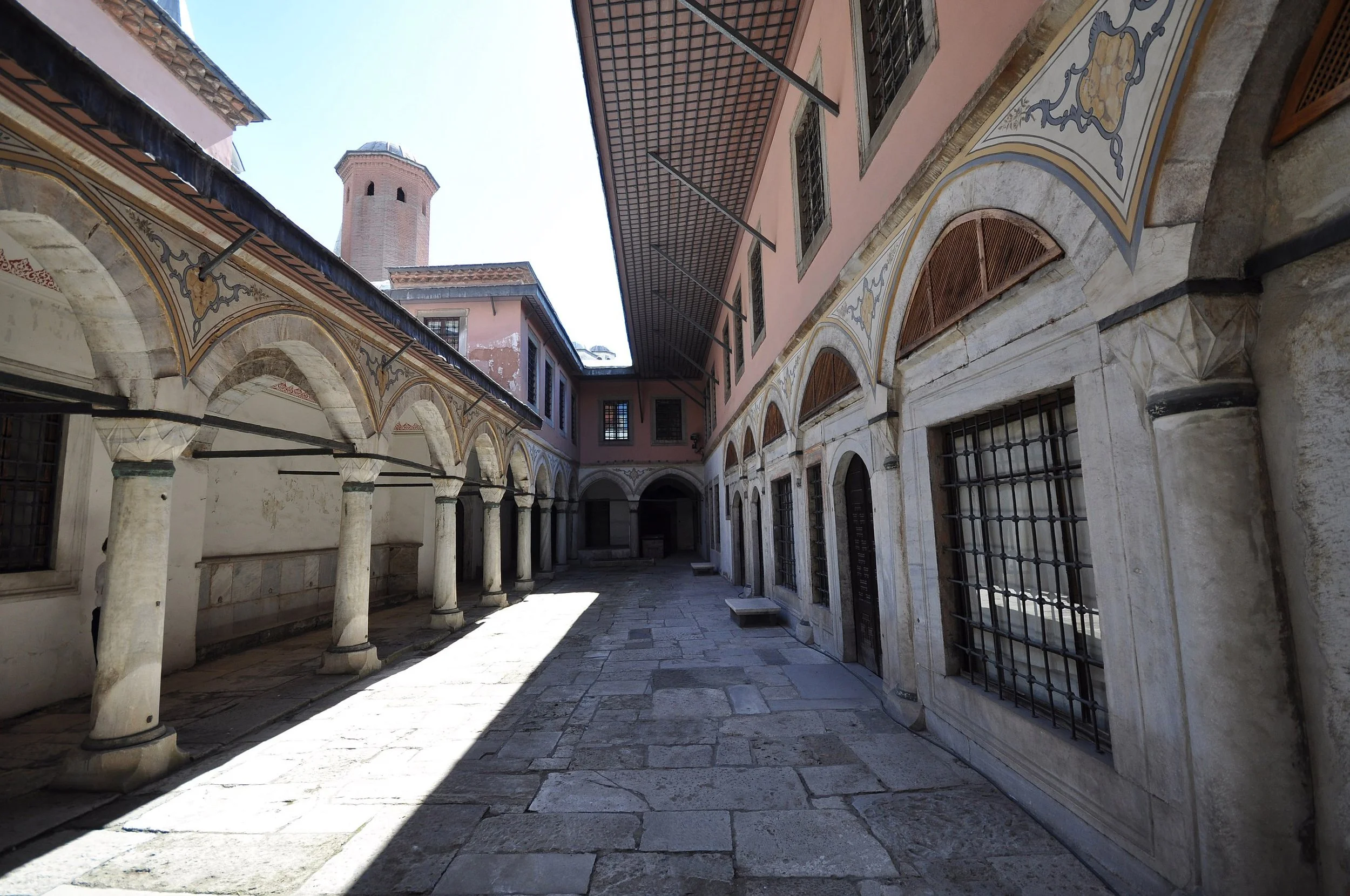
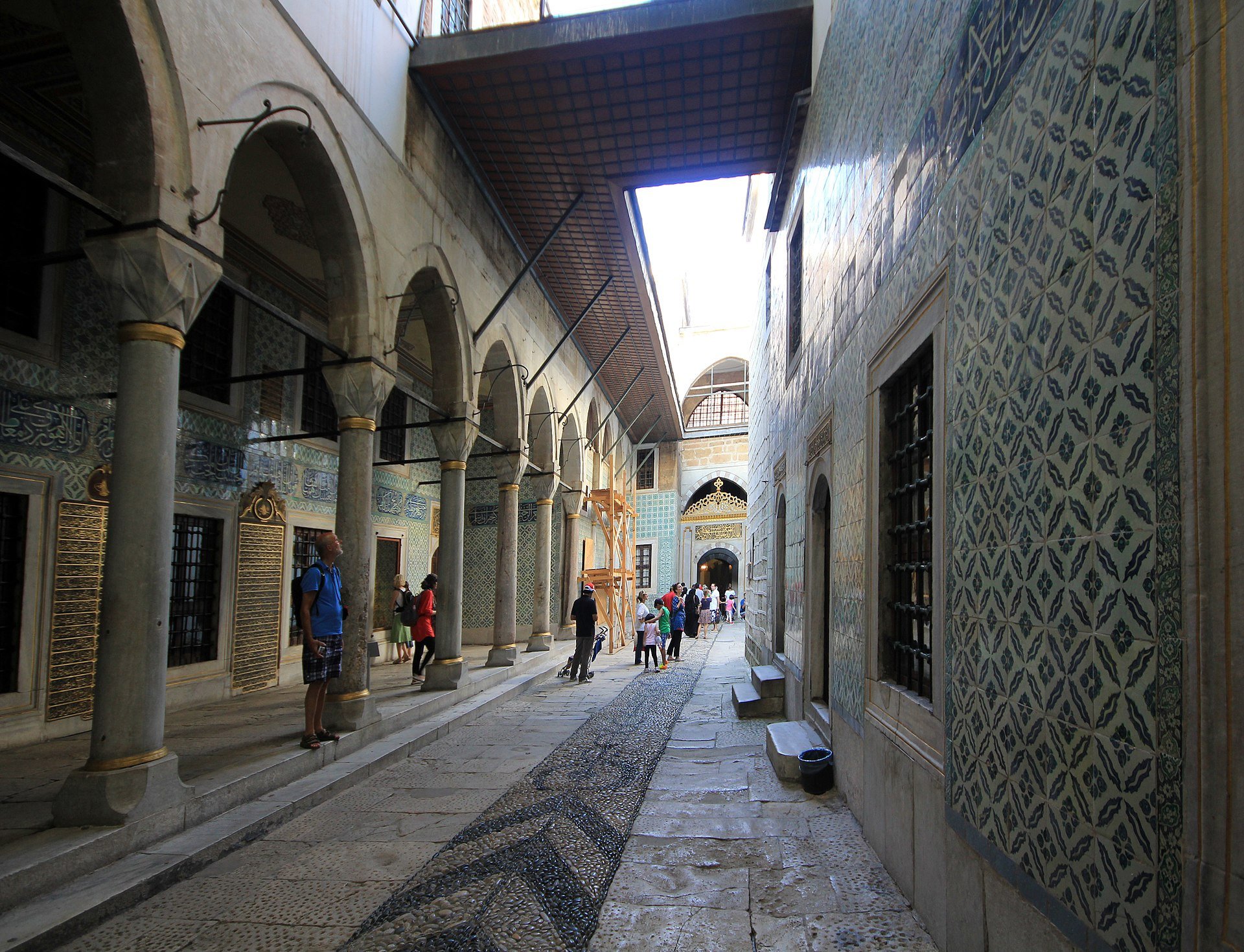
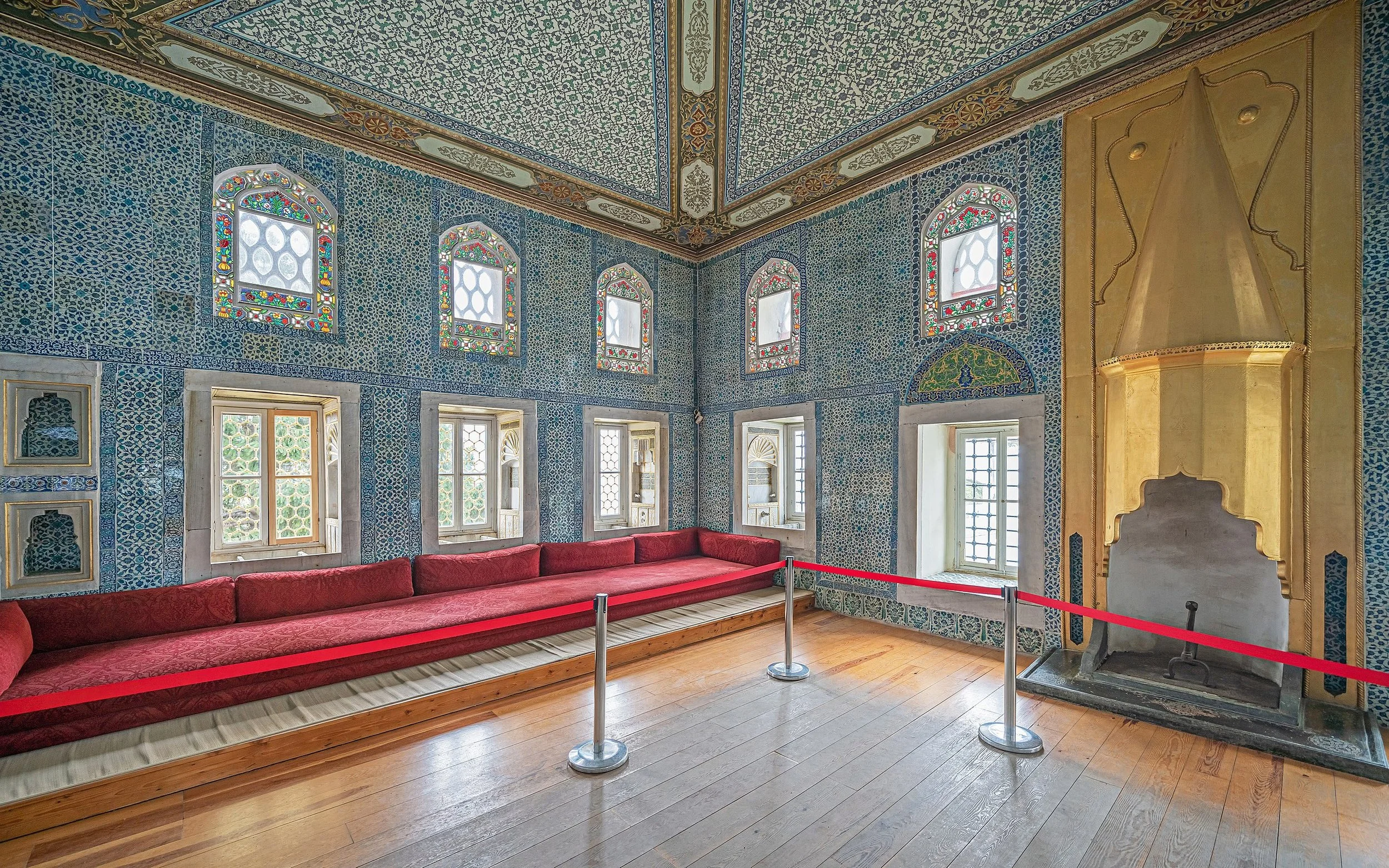
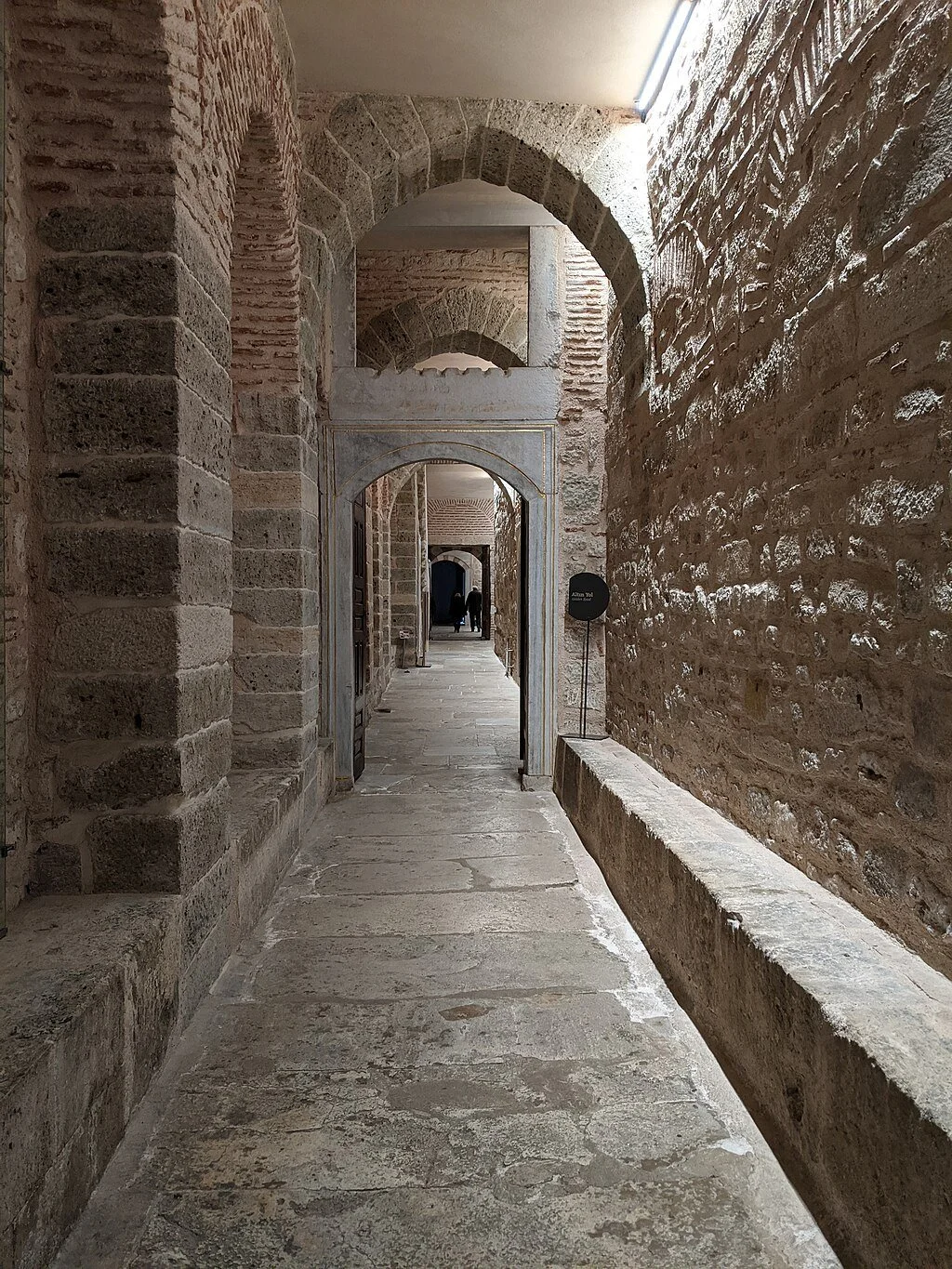
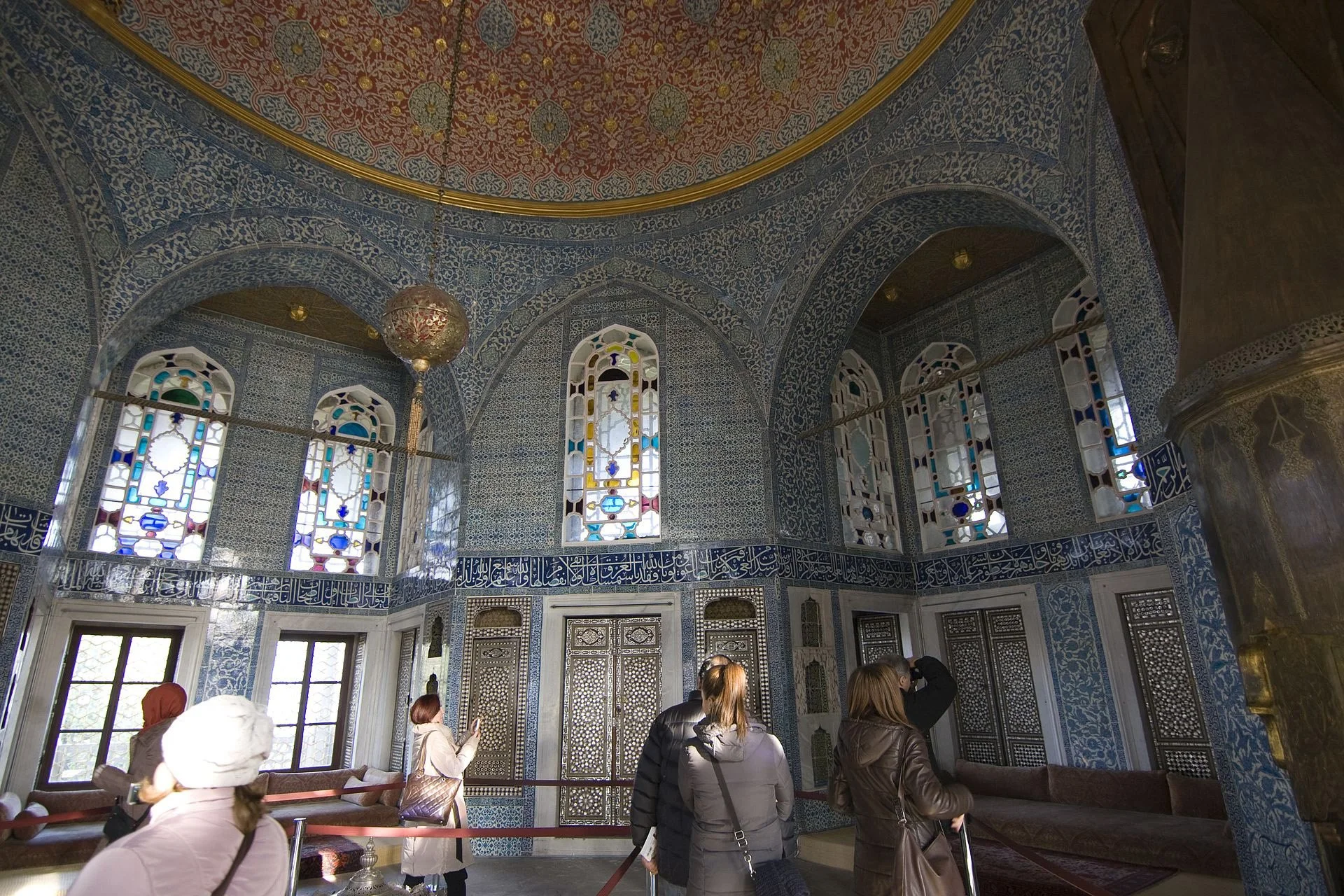
Mehmed II established the basic layout of the palace. His private quarters would be located at the highest point of the promontory. Various buildings and pavilions surrounded the innermost core and winded down the promontory towards the shores of the Bosphorus. The entire complex was surrounded by high walls, some of which date back to the Byzantine acropolis. This basic layout governed the pattern of future renovations and extensions. The layout and appearance of Topkapı Palace was unique amongst not only European travellers, but also Islamic or oriental palaces. European travellers described it as "irregular, asymmetric, non-axial, and un-monumental proportions". Ottomans called it "The Palace of Felicity". A strict, ceremonial, codified daily life ensured imperial seclusion from the rest of world. One of the central tenets was the observation of silence in the inner courtyards. The principle of imperial seclusion is a tradition that was codified by Mehmed II in 1477 and 1481 in the Kanunname Code, which regulated the rank order of court officials, the administrative hierarchy, and protocol matters. This principle of increased seclusion over time was reflected in the construction style and arrangements of various halls and buildings. The architects had to ensure that even within the palace, the sultan and his family could enjoy a maximum of privacy and discretion, making use of grilled windows and building secret passageways. Later sultans made various modifications to the palace, though Mehmed II's basic layout was mostly preserved. The palace was significantly expanded between 1520 and 1560, during the reign of Suleyman the Magnificent. The Ottoman Empire had expanded rapidly and Suleyman wanted his residence to reflect its growing power. The chief architect in this period was the Persian Alaüddin, also known as Acem Ali. He was also responsible for the expansion of the Harem.
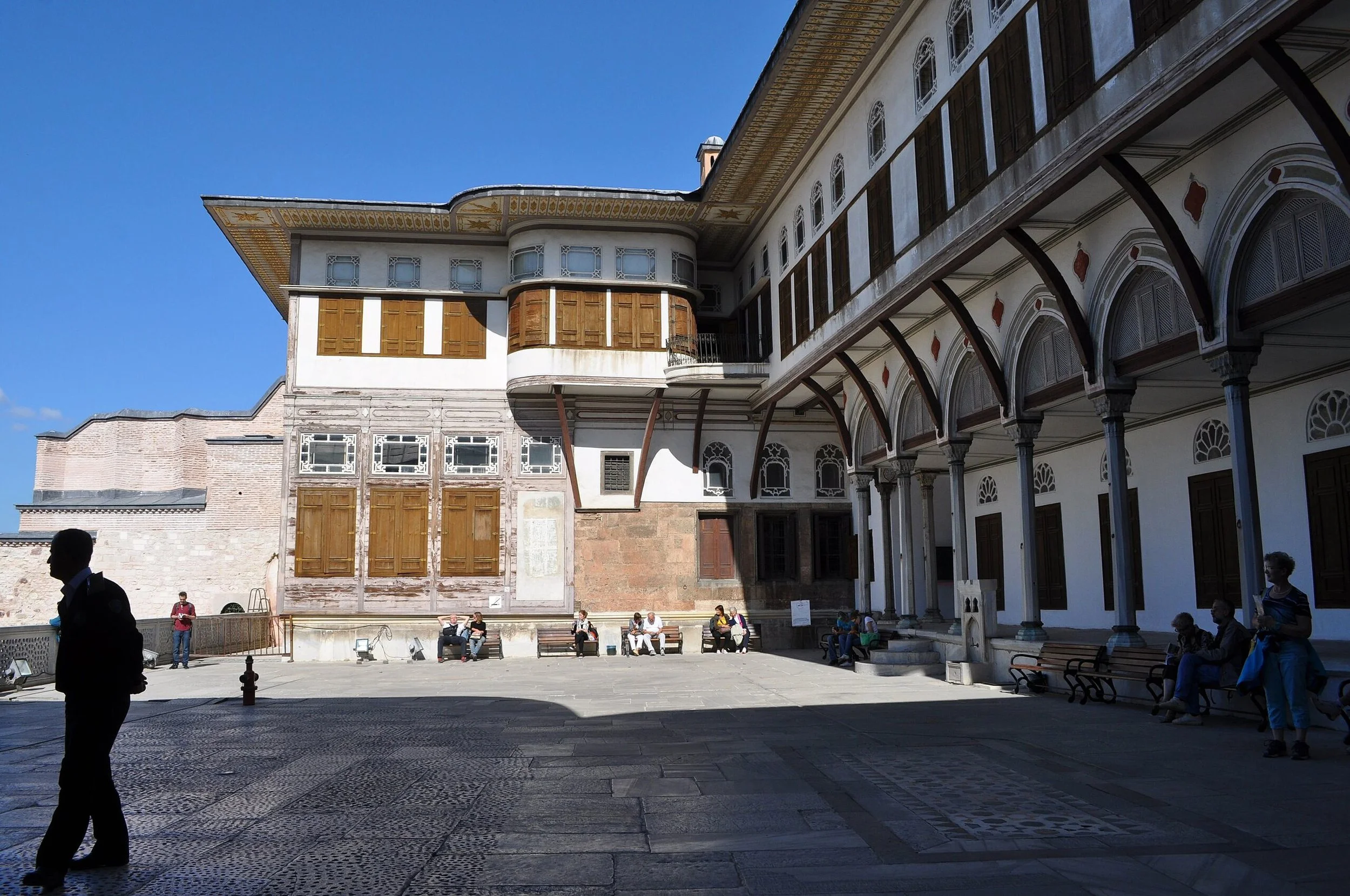
In 1574, after a great fire destroyed the kitchens, Mimar Sinan was entrusted by Sultan Selim II to rebuild the damaged parts of the palace. Mimar Sinan restored and expanded not only the damaged areas, but also the Harem, baths, the Privy Chamber and various shoreline pavilions. By the end of the 16th century, the palace had acquired its present appearance. The palace is an extensive complex rather than a single monolithic structure, with an assortment of low buildings constructed around courtyards, interconnected with galleries and passages. Few of the buildings exceed two stories. Seen from above, the palace grounds are divided into four main courtyards and the harem. The first courtyard was the most accessible, while the fourth courtyard and the harem were the most inaccessible. Access to these courtyards was restricted by high walls and controlled with gates. Apart from the four to five main courtyards, various other small to mid-sized courtyards exist throughout the complex. Estimates of the total size of the complex varies from around 592,600 m2 (146.4 acres) to 700,000 m2 (173 acres).
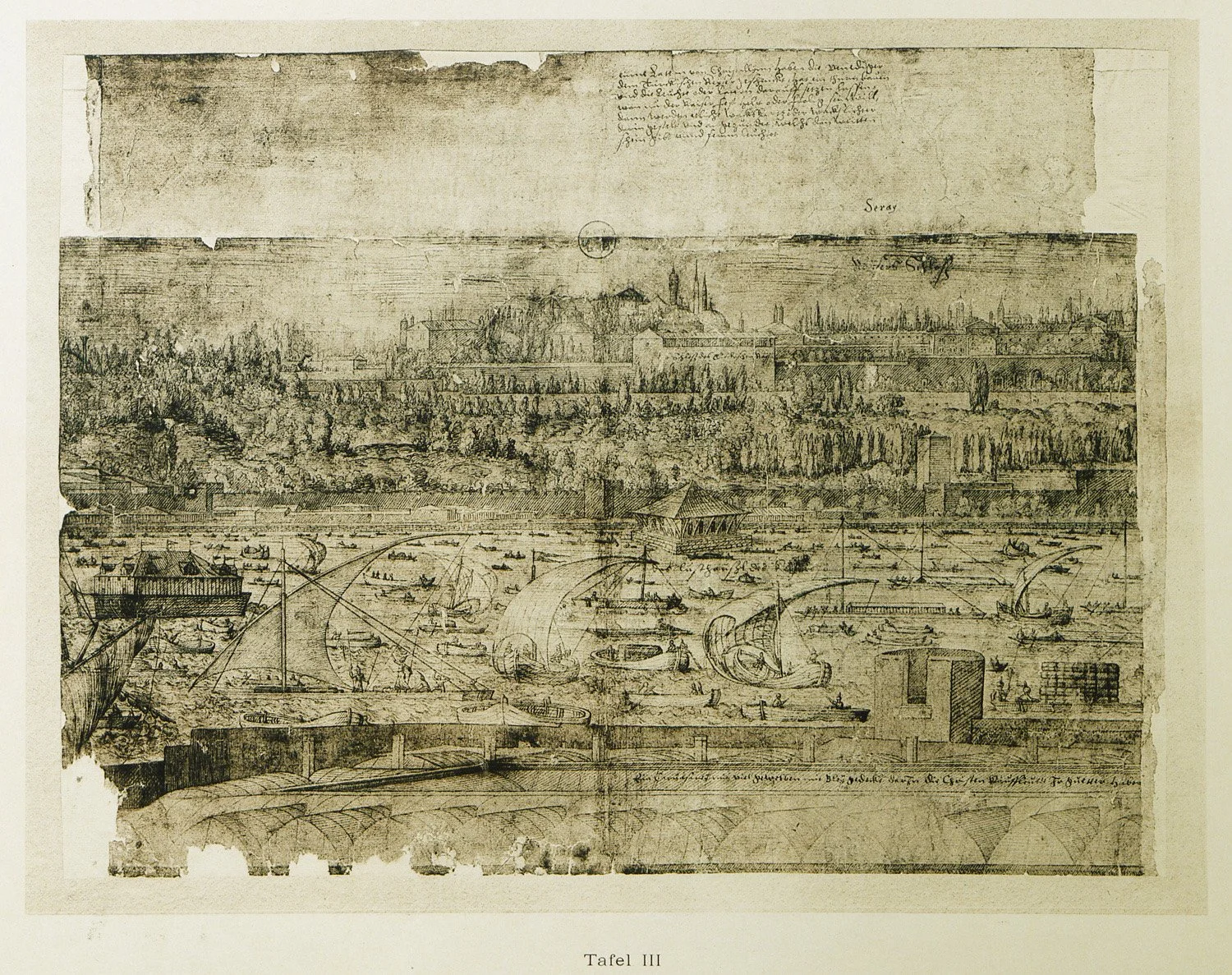
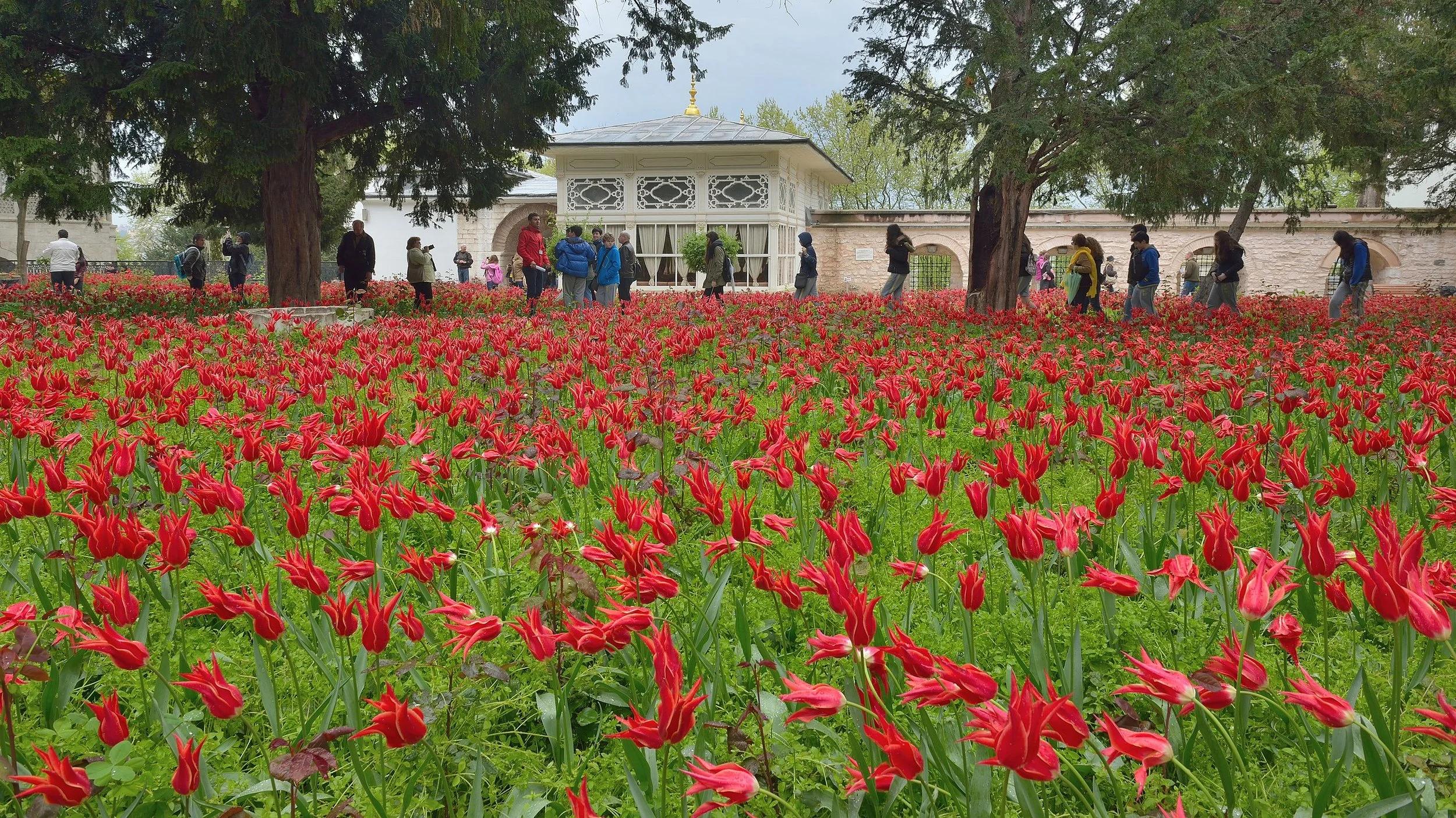
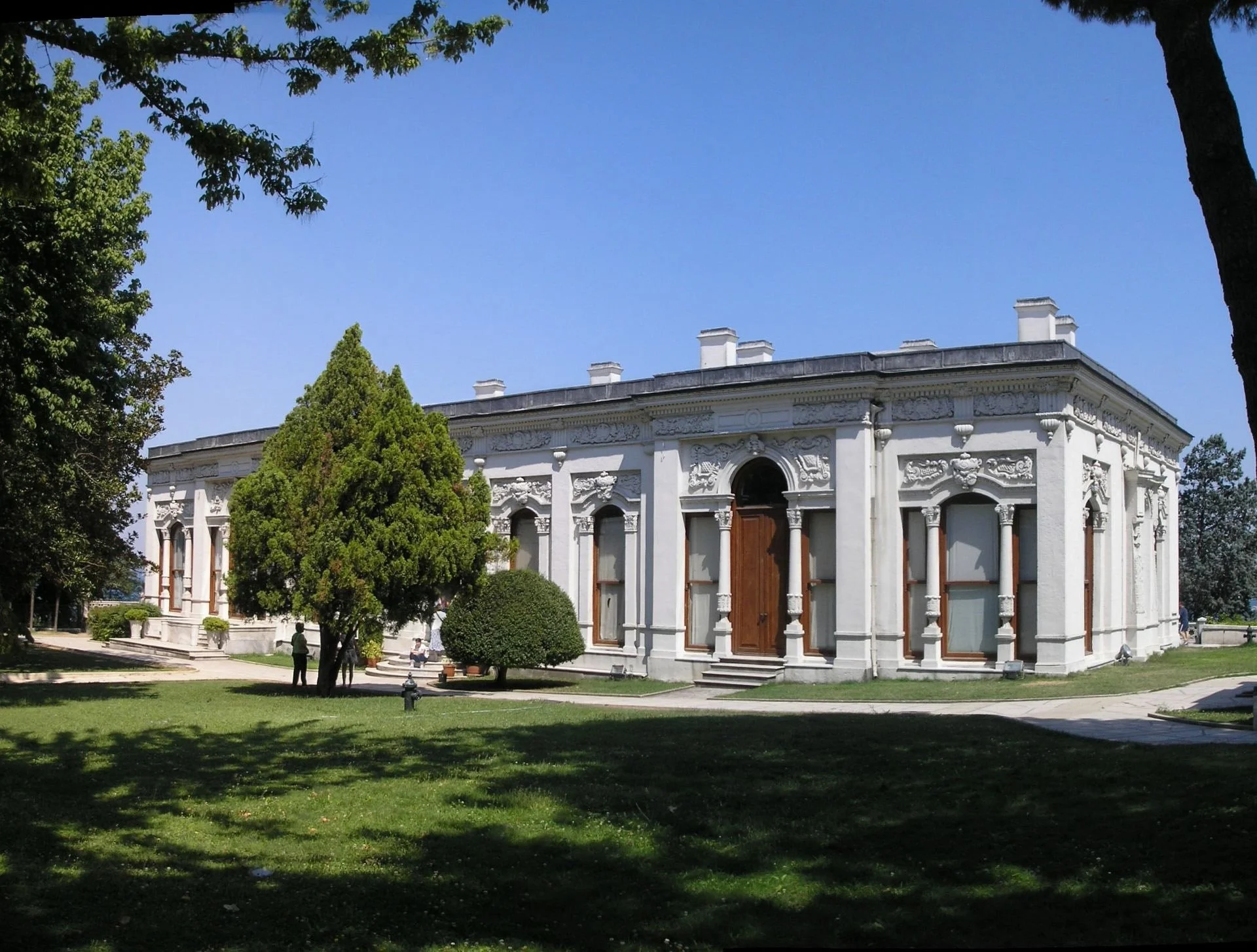
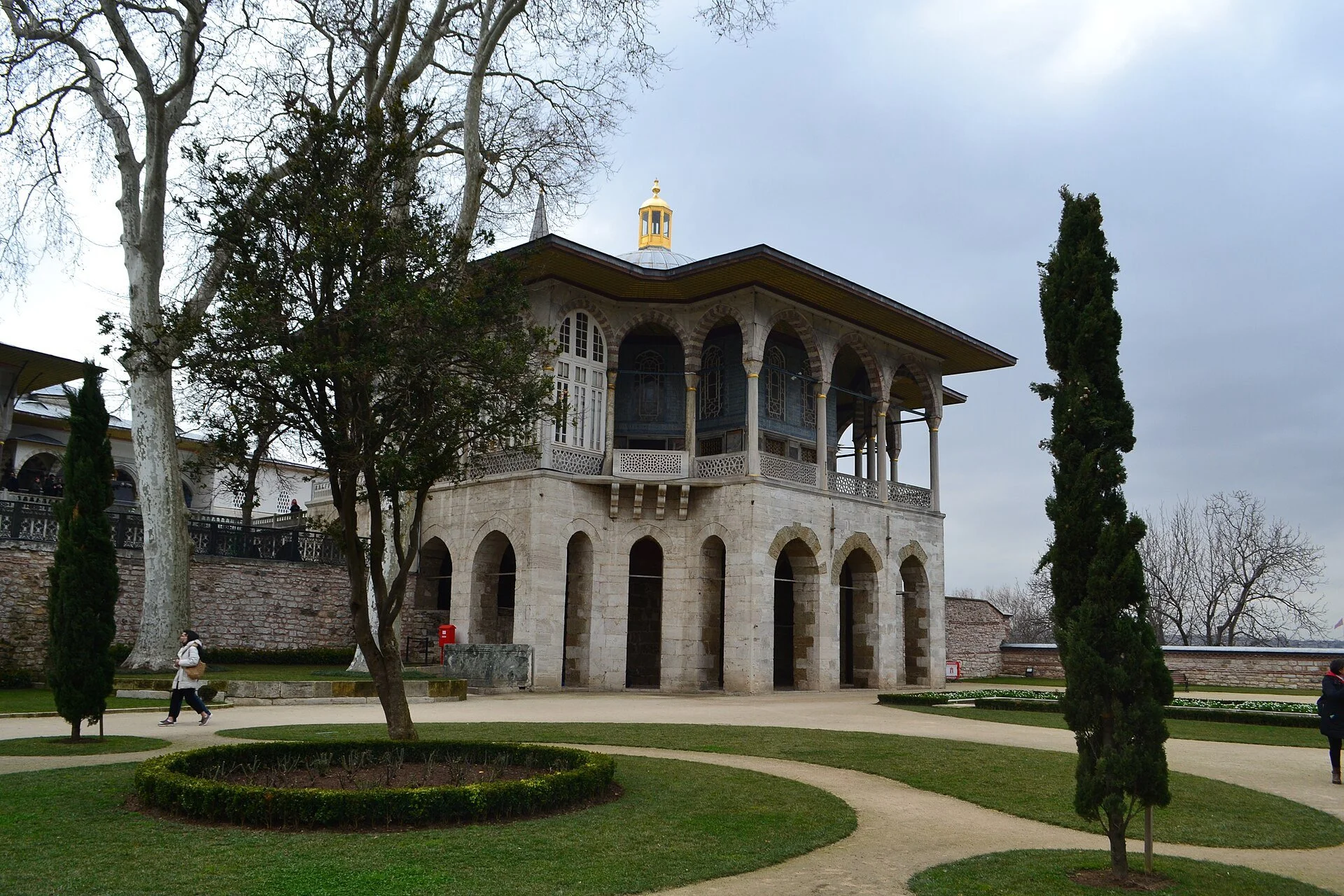
To the west and south the complex is bordered by the large imperial flower park, known today as Gülhane Park. Various related buildings such as small summer palaces (kasır), pavilions, kiosks (köşk) and other structures for royal pleasures and functions formerly existed at the shore in an area known as the Fifth Courtyard, but have disappeared over time due to neglect and the construction of the shoreline railroad in the 19th century. The last remaining seashore structure that still exists today is the Basketmakers' Kiosk, constructed in 1592 by Sultan Murad III.
Imperial Gate
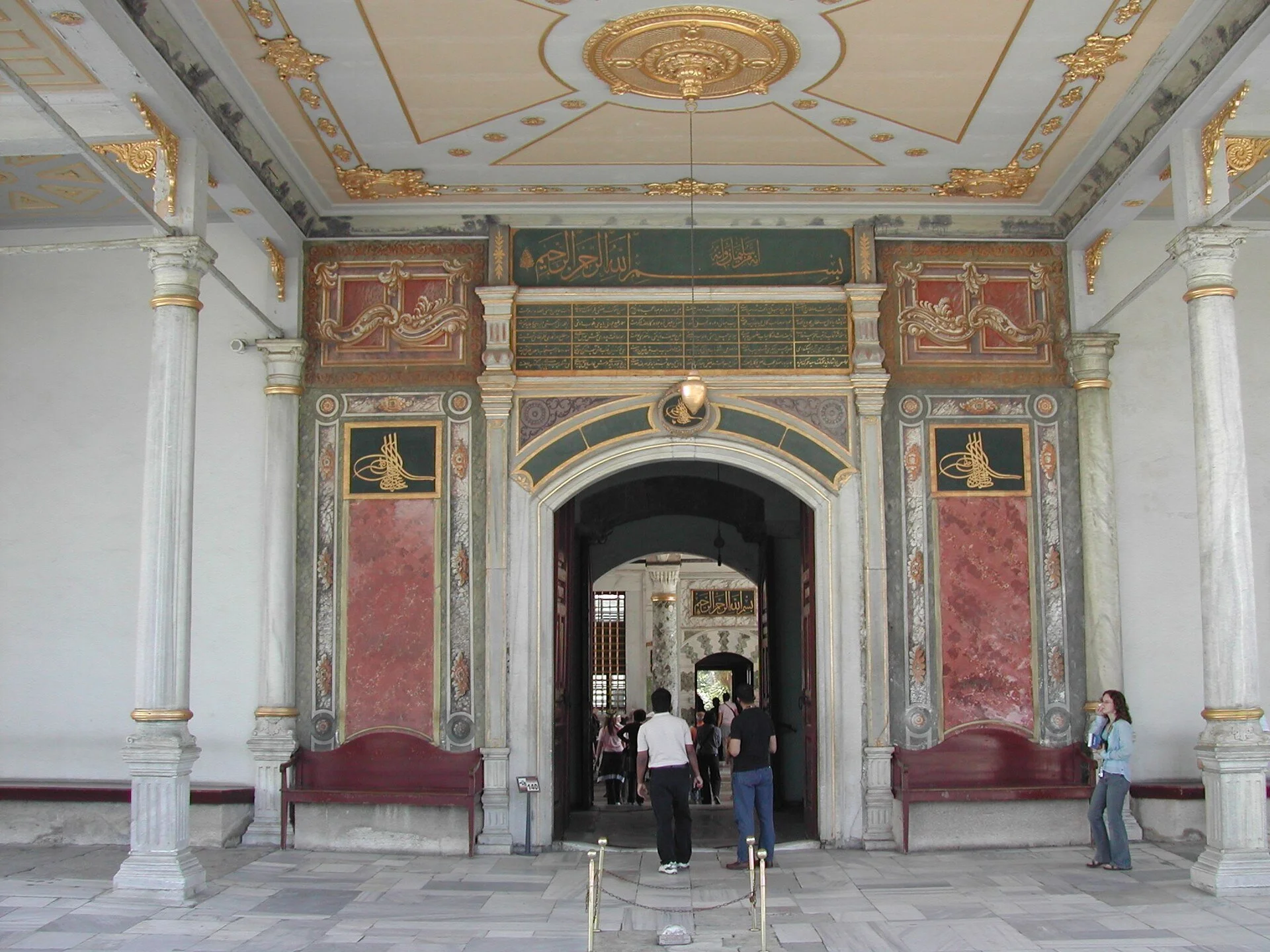
The main street leading to the palace is the Byzantine processional Mese avenue, known today as Divan Yolu (Council Street). This street was used for imperial processions during the Byzantine and Ottoman era. It leads directly to the Hagia Sophia and turns northwest towards the palace square to the Fountain of Ahmed III. The Imperial Gate is the main entrance into the First Courtyard. The sultan would enter the palace through the Imperial Gate (Turkish: Bâb-ı Hümâyûn, meaning "Royal Gate" in Persian, or Saltanat Kapısı) located to the south of the palace. This massive gate, originally dating from 1478, is now covered in 19th-century marble. Its central arch leads to a high-domed passage; gilded Ottoman calligraphy adorns the structure at the top, with verses from the Qur'an and tughras of the sultans. The tughras of Mehmed II and Abdulaziz, who renovated the gate, have been identified. According to old documents, there was a wooden apartment above the gate area until the second half of the 19th century. It was used as a pavilion by Mehmed, a depository for the properties of those who died inside the palace without heirs and the receiving department of the treasury. It has also been used as a vantage point for the ladies of the harem on special occasions.
First Courtyard
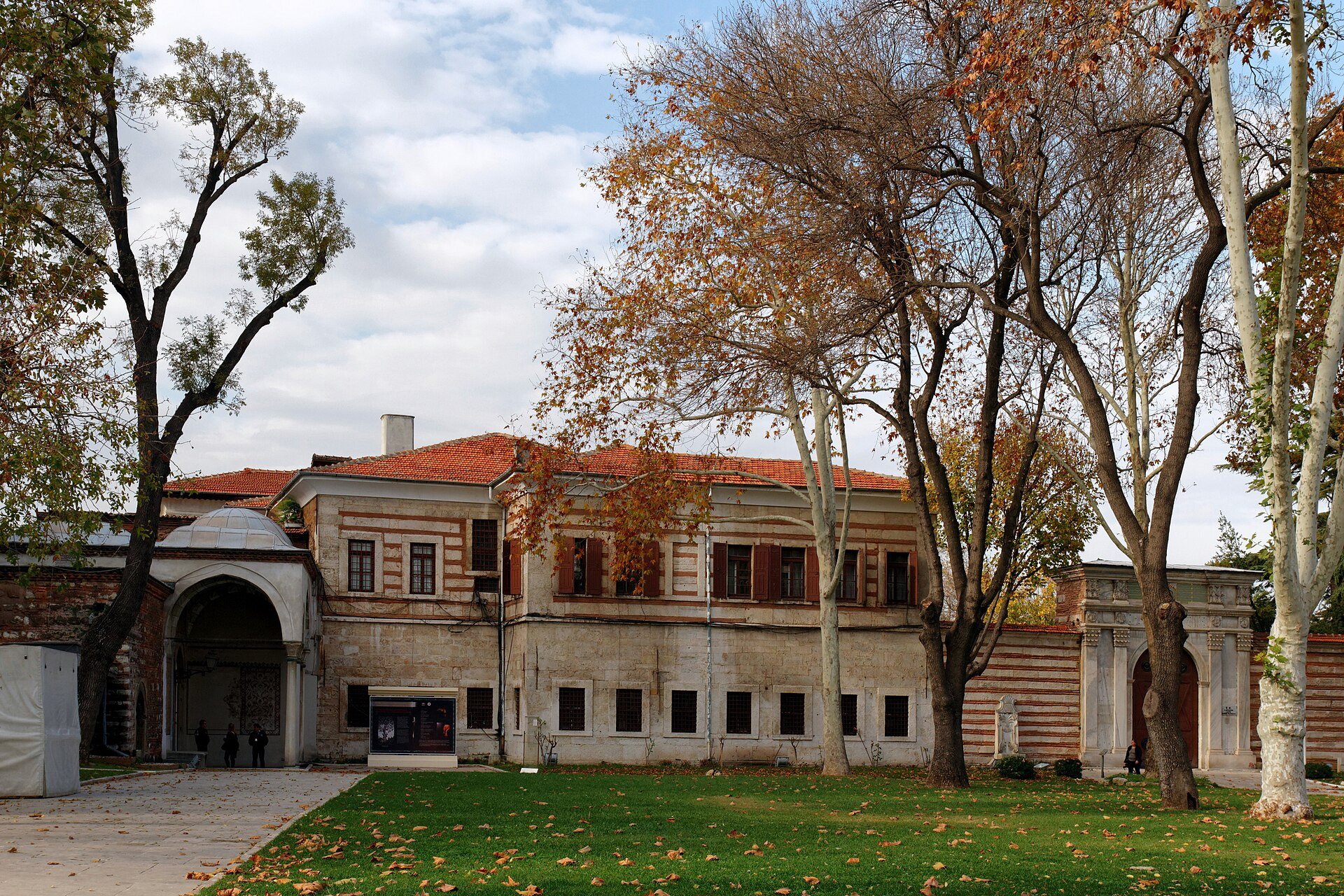
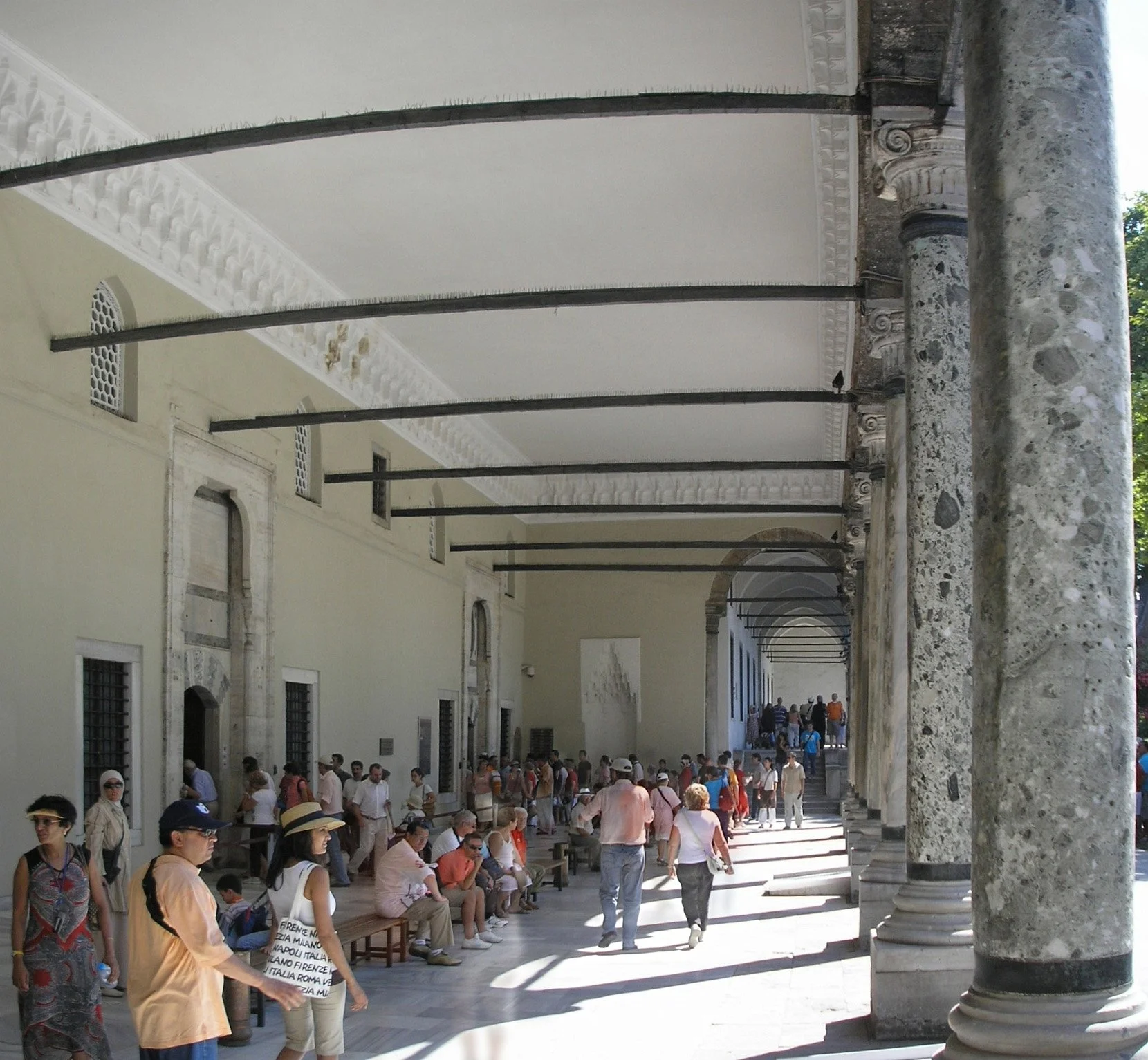
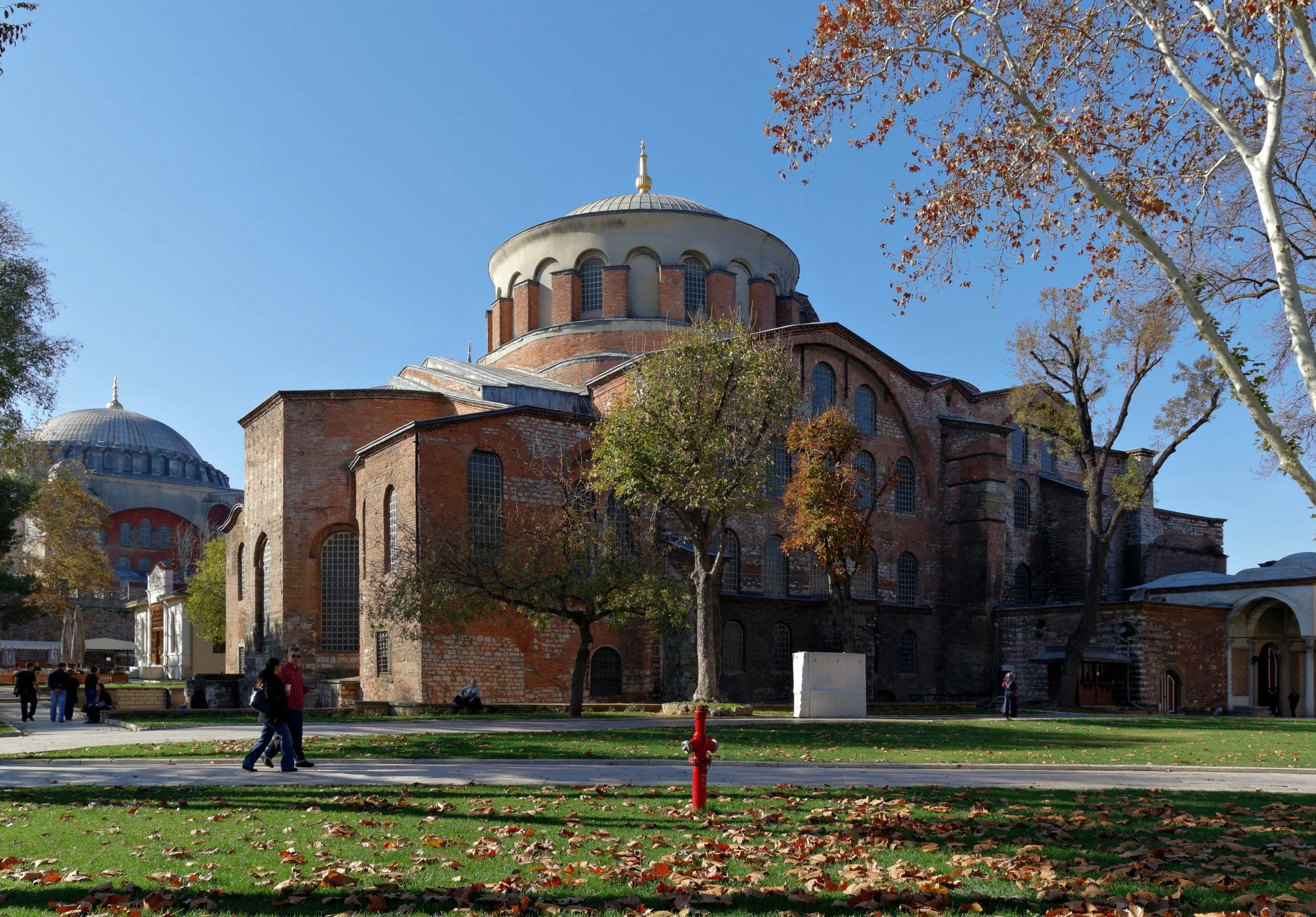
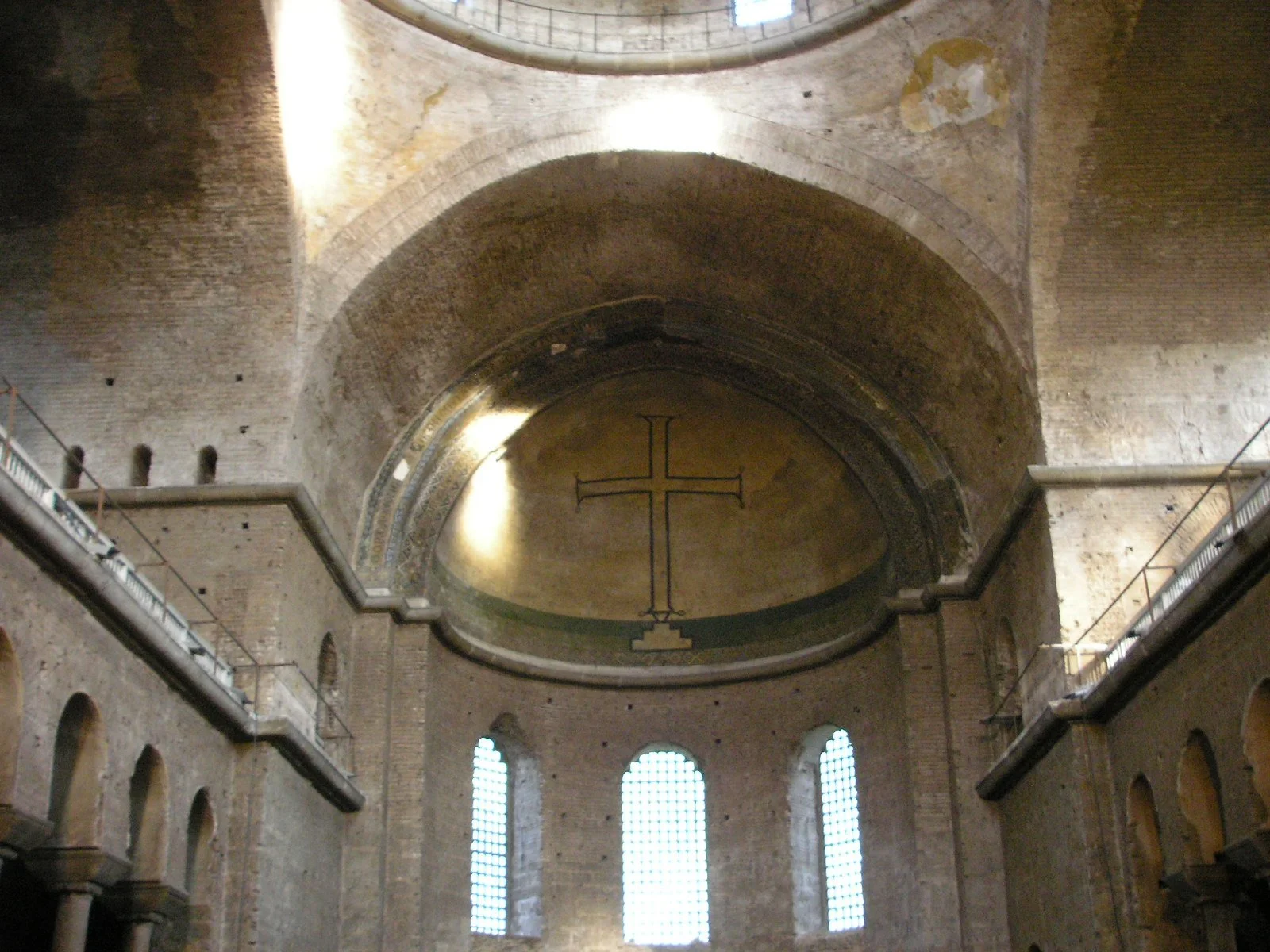
Surrounded by high walls, the First Courtyard (I. Avlu or Alay Meydanı) functioned as an outer precinct or park and is the largest of all the courtyards of the palace. The steep slopes leading towards the sea had already been terraced under Byzantine rule. Some of the historical structures of the First Courtyard no longer exist. The structures that remain are the former Imperial Mint (Darphane-i Âmire, constructed in 1727), the church of Hagia Irene and various fountains. The Byzantine church of Hagia Irene was used by the Ottomans as a storehouse and imperial armoury. This courtyard was also known as the Court of the Janissaries or the Parade Court. Court officials and janissaries would line the path dressed in their best garb. Visitors entering the palace would follow the path towards the Gate of Salutation and the Second Courtyard of the palace.
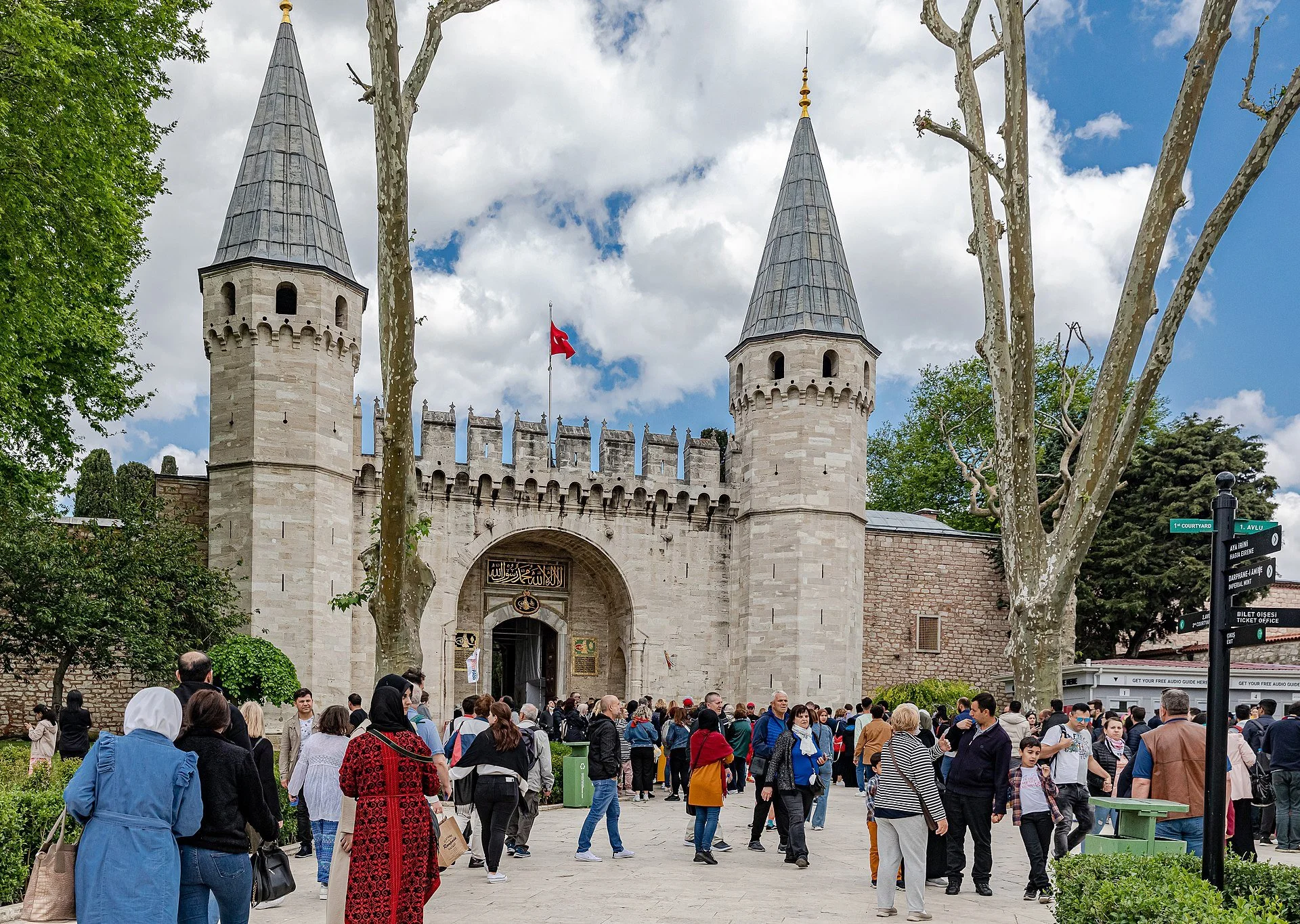
The large Gate of Salutation, also known as the Middle Gate (Turkish: Orta Kapı), leads into the palace and the Second Courtyard. This crenellated gate has two large, pointed octagonal towers. Its date of construction is uncertain; the architecture of the towers appears to be of Byzantine influence. An inscription at the door dates this gate to at least 1542. The gate is richly decorated with religious inscriptions and monograms of sultans. Passage through the gate was tightly controlled and all visitors had to dismount, since only the sultan was allowed to enter the gate on horseback. This was also a Byzantine tradition taken from the Chalke Gate of the Great Palace. The Fountain of the Executioner (Cellat Çeşmesi) is where the executioner purportedly washed his hands and sword after a decapitation, though there is disagreement about whether the fountain was actually used for this purpose. It is located on the right side when facing the Gate of Salutation from the First Courtyard.
Second Courtyard
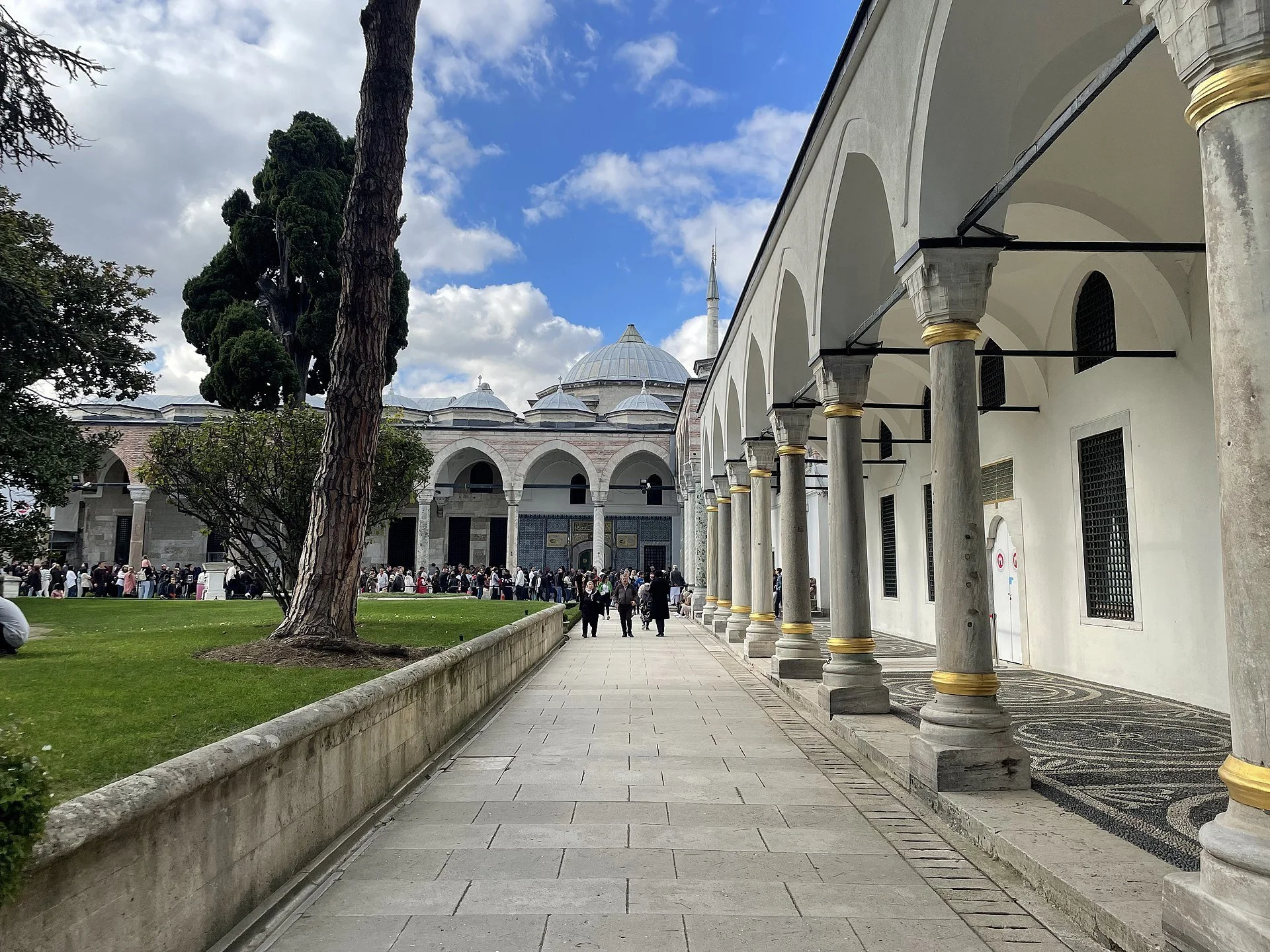
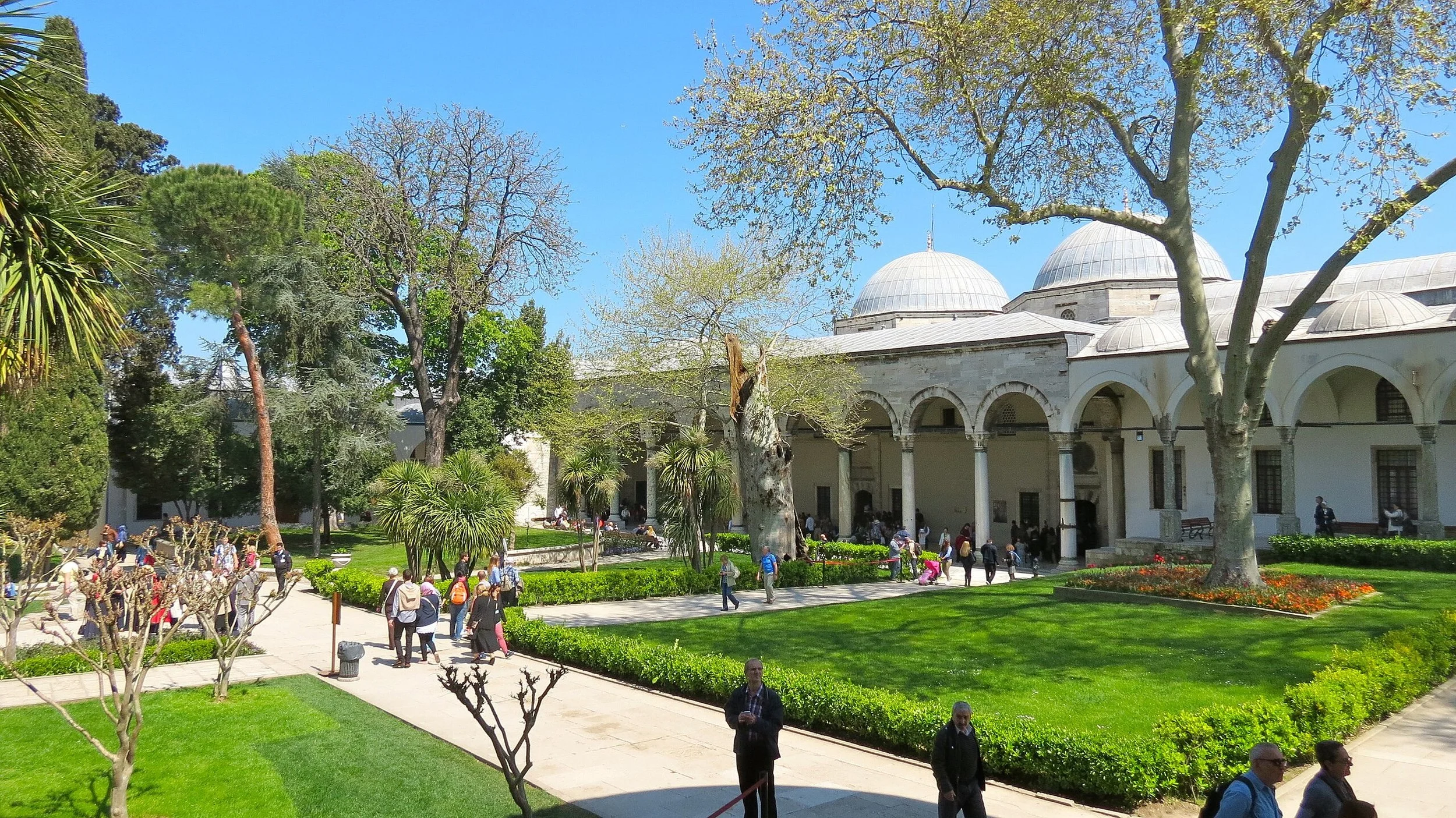
Through the middle gate is the Second Courtyard (II. Avlu), or Divan Square (Divan Meydanı). The courtyard was probably completed around 1465, during the reign of Mehmed II. It received its final appearance around 1525–1529 during the reign of Suleyman I. It is surrounded by the former palace hospital, bakery, Janissary quarters, stables, the imperial harem and Divan to the north and the kitchens to the south. At the end of the courtyard, the Gate of Felicity marks the entrance to the Third Courtyard. Numerous artifacts from the Roman and Byzantine periods that have been found on the palace site during recent excavations, including sarcophagi, are on display in the Second Courtyard in front of the imperial kitchens. Located underneath the Second Courtyard is a cistern that dates to Byzantine times. During Ottoman times this courtyard would have been full of peacocks and gazelles. It was used as a gathering place for courtiers. The Sultan, seated on the gold-plated Bayram throne, used to hold audiences in the second courtyard. Some foreign dignitaries, including the French ambassador Philippe du Fresne-Canaye, have written accounts about these audiences.
The imperial stables (Istabl-ı Âmire), located around five to six meters below ground level, were constructed under Mehmed II and renovated under Suleyman. A vast collection of harness "treasures" (Raht Hazinesi) are kept in the privy stables. This area also has a small 18th-century mosque and the bath of Beşir Ağa (Beşir Ağa Camii ve Hamamı), who was the chief black eunuch of Mahmud I.
At the end of the imperial stables are the Dormitories of the Halberdiers with Tresses (Zülüflü Baltacılar Koğuşu). The responsibilities of the halberdiers included carrying wood to the palace rooms and service for some of the palace quarters. The halberdiers wore long tresses to signify their higher position. The first mention of this corps is around 1527, when they were established to clear the roads ahead of the army during a campaign. The dormitory was founded in the 15th century. It was enlarged by the chief architect Davud Ağa in 1587, during the reign of Sultan Murad III. The dormitories are constructed around a main courtyard in the traditional layout of an Ottoman house, with baths and a mosque, as well as recreational rooms such as a pipe-room. On the outside and inside of the complex, many pious foundation inscriptions about the various duties and upkeep of the quarters can be found. In contrast to the rest of the palace, the quarters are constructed of red and green painted wood.
Palace kitchens and porcelain collection
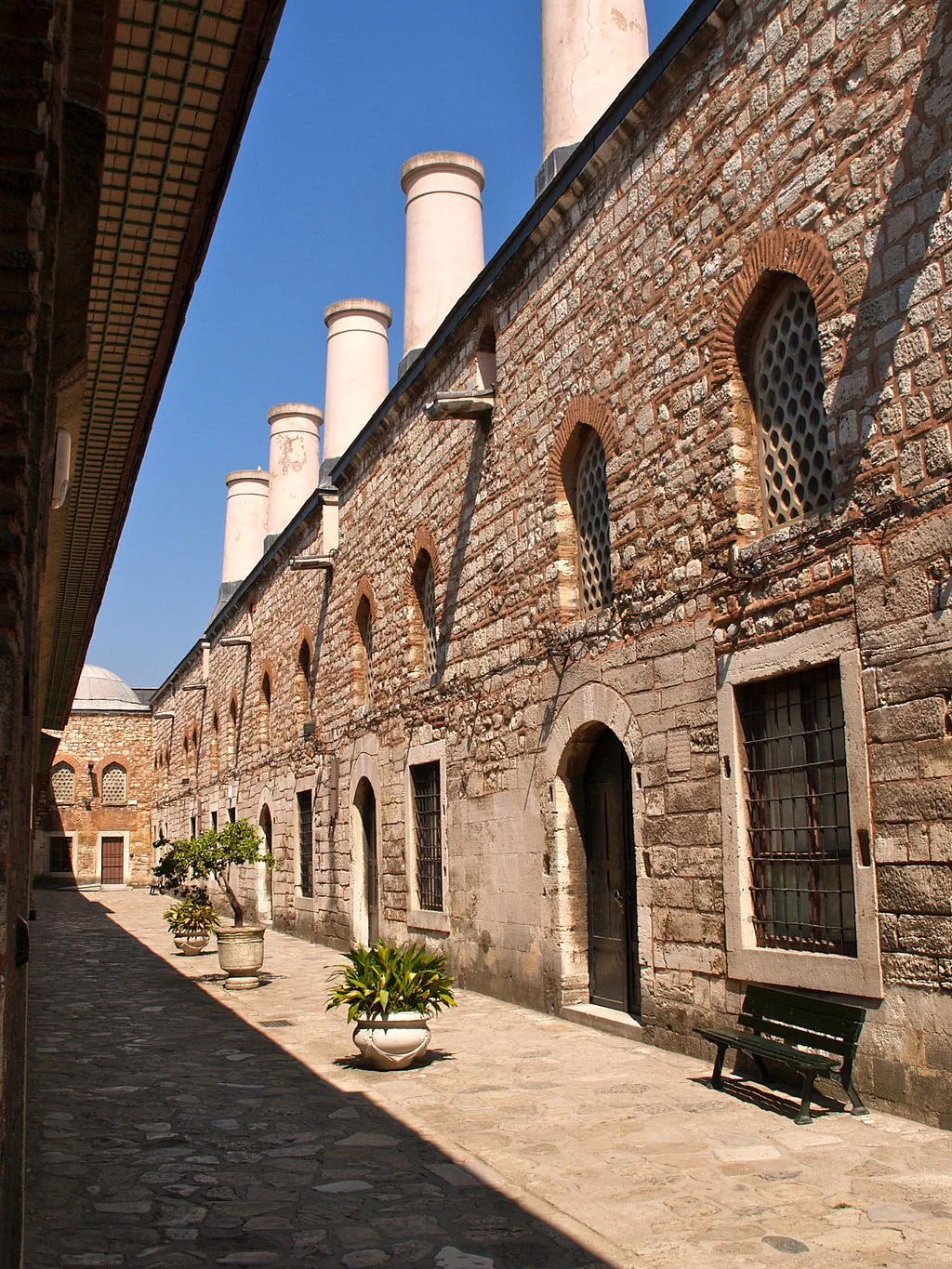
The palace kitchens (Saray Mutfakları) were built when the palace was first constructed in the 15th century and expanded during the reign of Suleyman the Magnificent. They were modeled on the kitchens of Edirne Palace. After the fire of 1574, which damaged the kitchens, they were remodeled by the court architect Mimar Sinan. The rebuilt kitchens form two rows of 20 wide chimneys; these chimneys were added by Mimar Sinan.
The kitchens are located on an internal street stretching between the Second Courtyard and the Marmara Sea. The entrance to this section is through the three doors in the portico of the Second Courtyard: the Imperial commissariat (lower kitchen) door, imperial kitchen door and the confectionery kitchen door. The palace kitchens consist of 10 domed buildings: Imperial kitchen, (palace school), Harem (women's quarters), Birûn (outer service section of the palace), kitchens, beverages kitchen, confectionery kitchen, creamery, storerooms and rooms for the cooks. They were the largest kitchens in the Ottoman Empire. Food was prepared for about 4,000 people and the kitchen staff consisted of more than 800 people. The kitchens included dormitories, baths and a mosque for the employees, most of which disappeared over time.
Apart from exhibiting kitchen utensils, today the buildings contain a silver gifts collection, as well as a large collection of porcelain. The Ottomans had access to Chinese porcelains from the mid-fifteenth century onward. Although official Chinese sources have documented that some Ottoman envoys paid tributary visits to China and received gifts, including porcelain wares, from the Chinese emperor as rewards, no sources on the Ottoman side substantiate such official missions. The collection of 10,700 pieces of Chinese porcelain is among the finest porcelain collections in the world. Porcelains often entered the palace collection as parts of the estates of deceased persons, and were sometimes circulated as gifts amongst members of the royal family or other leading officials. Records indicate that by the 18th century the palace collection had 16,566 pieces of Chinese porcelain, compared to 400 pieces in the 16th century and 3,645 pieces in the 17th century. The Chinese porcelain collection ranges from the late Song Dynasty (960-1279) and the Yuan Dynasty (1280–1368), through the Ming Dynasty (1368–1644) to the Qing Dynasty (1644–1911). The pieces include celadons as well as blue and white porcelain. The Japanese collection is mainly Imari porcelain, dating from the 17th to the 19th centuries. The collection also includes around 5,000 European pieces. Researchers believe that Ottoman tastes changed over time to favor various types of European porcelain by the 18th century.
Imperial Council
The Imperial Council (Dîvân-ı Hümâyûn) building is the chamber where the Imperial Council—consisting of the Grand Vizier (Vazīr-e Azam) and other council ministers (Dîvân Heyeti)—held meetings. The domed chamber of the building is called Kubbealtı, which means "under the dome". The council building situated in the northwestern corner of the courtyard next to the Gate of Felicity.
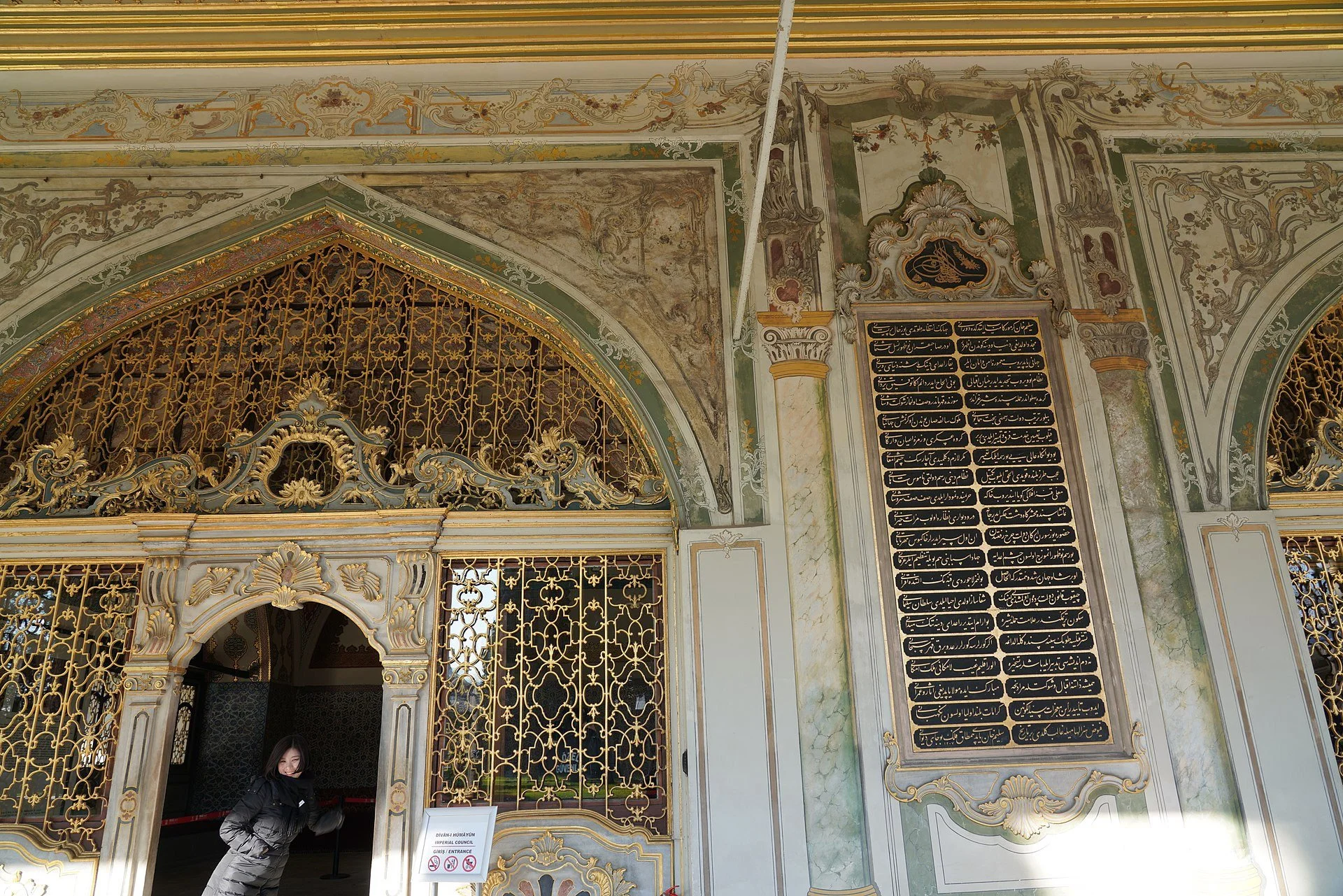
The Imperial Council building was first built during the reign of Mehmed II. The present building dates from the period of Süleyman the Magnificent; the chief architect was Alseddin. It had to be restored after the Harem fire of 1665. According to the entrance inscription it was also restored during the periods of Selim III and Mahmud II; on its façade are verse inscriptions that mention the restoration work carried out in 1792 and 1819 by Sultan Selim III and Mahmud II. The rococo decorations on the façade and inside the Imperial Council date from this period.
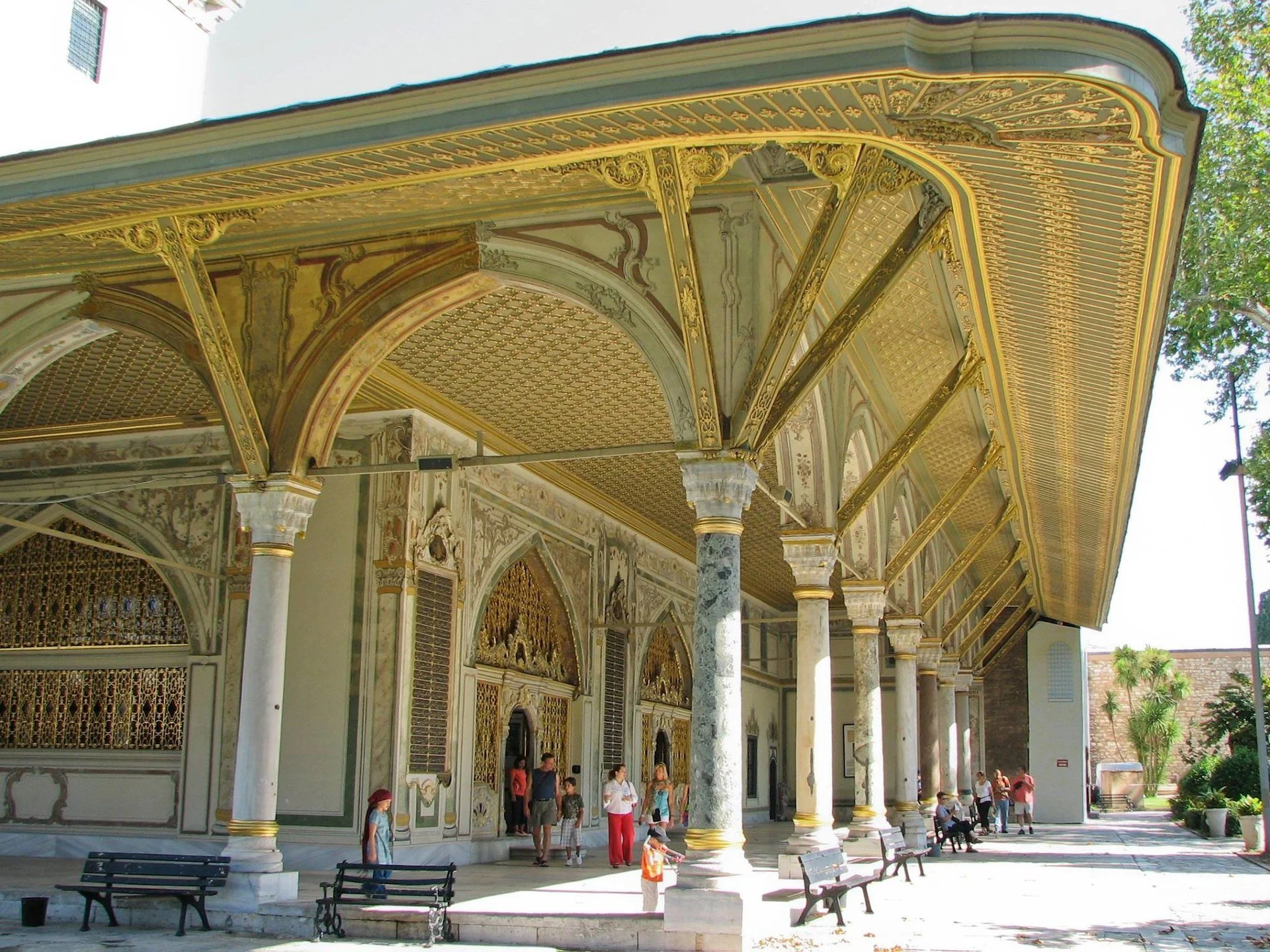
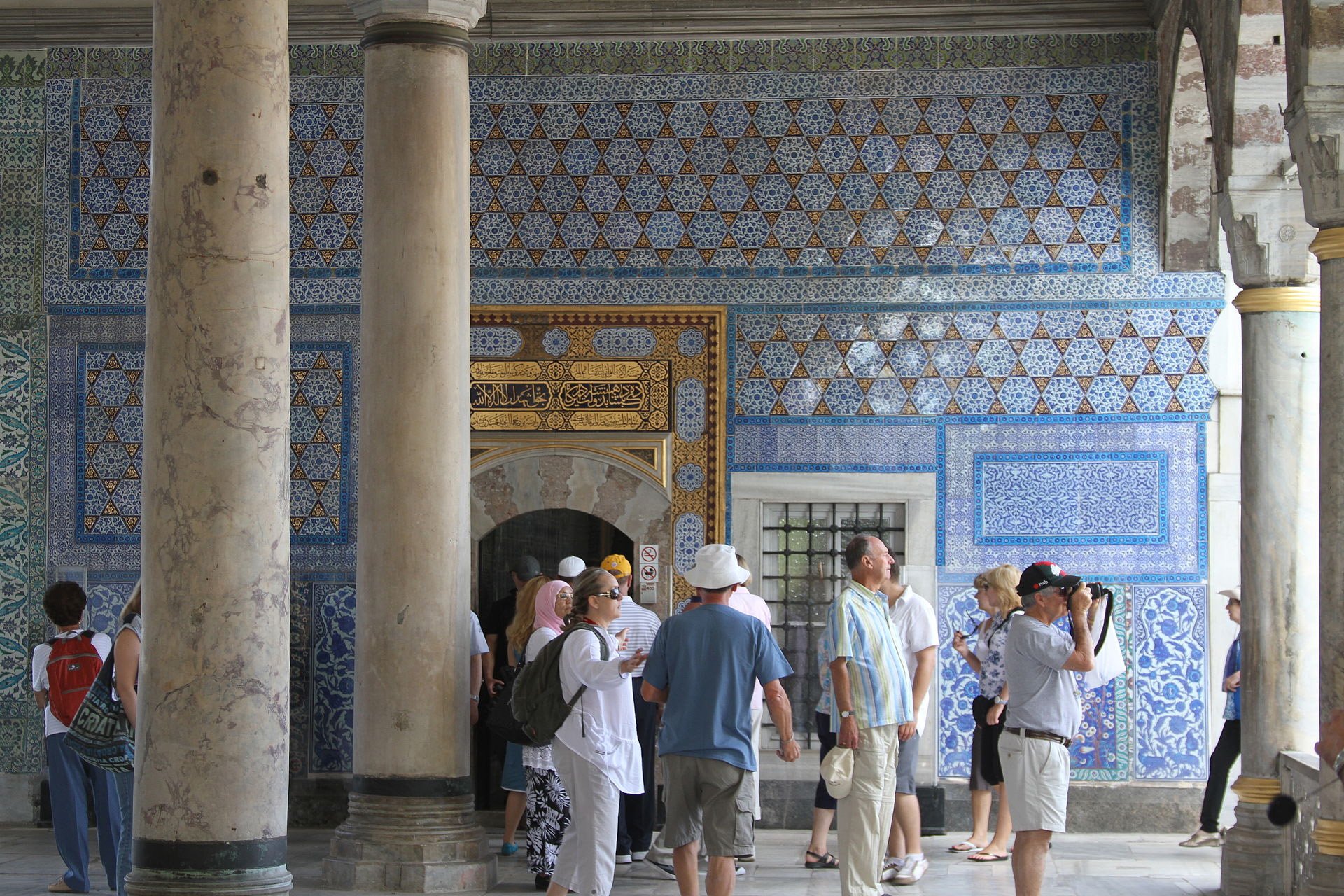
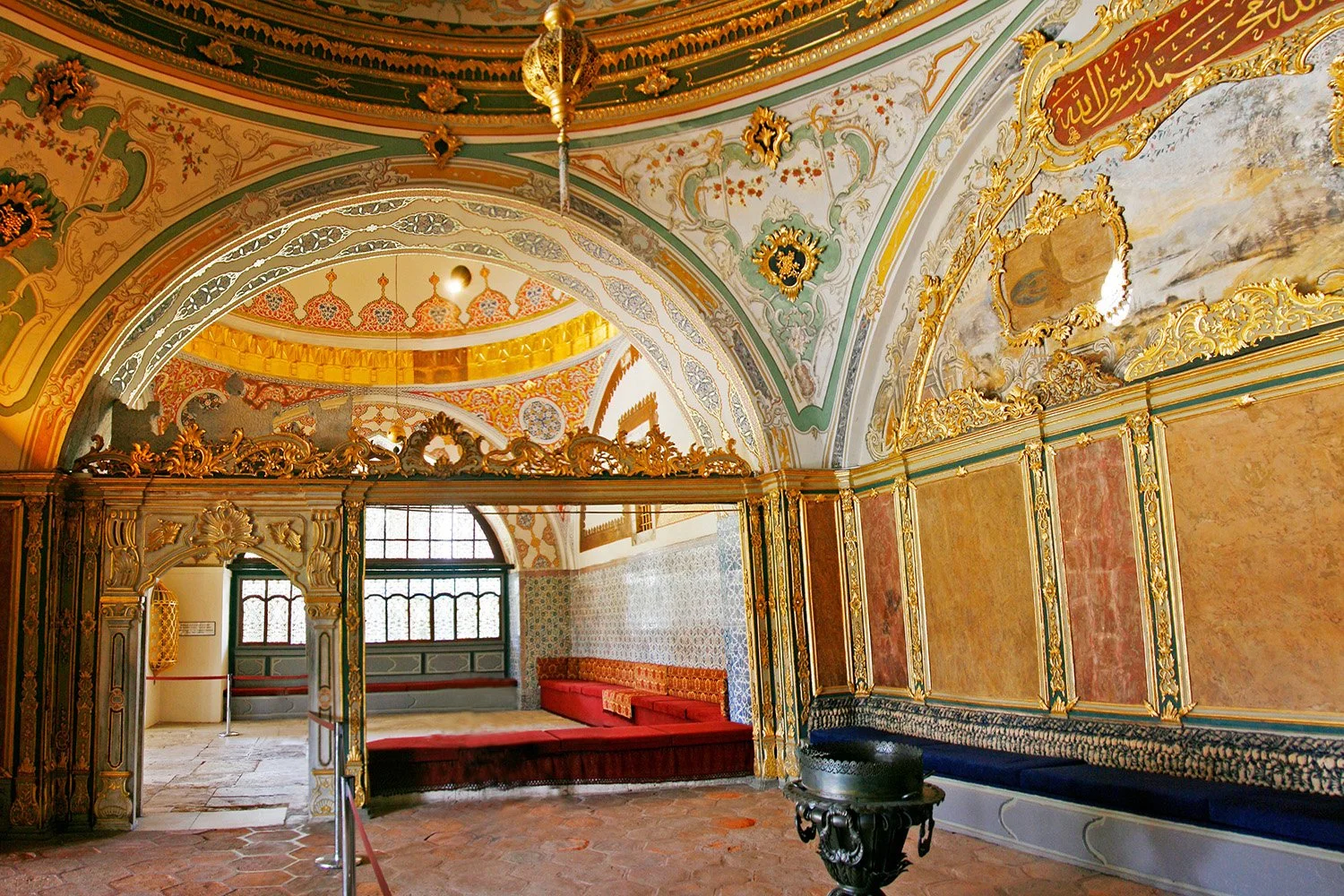
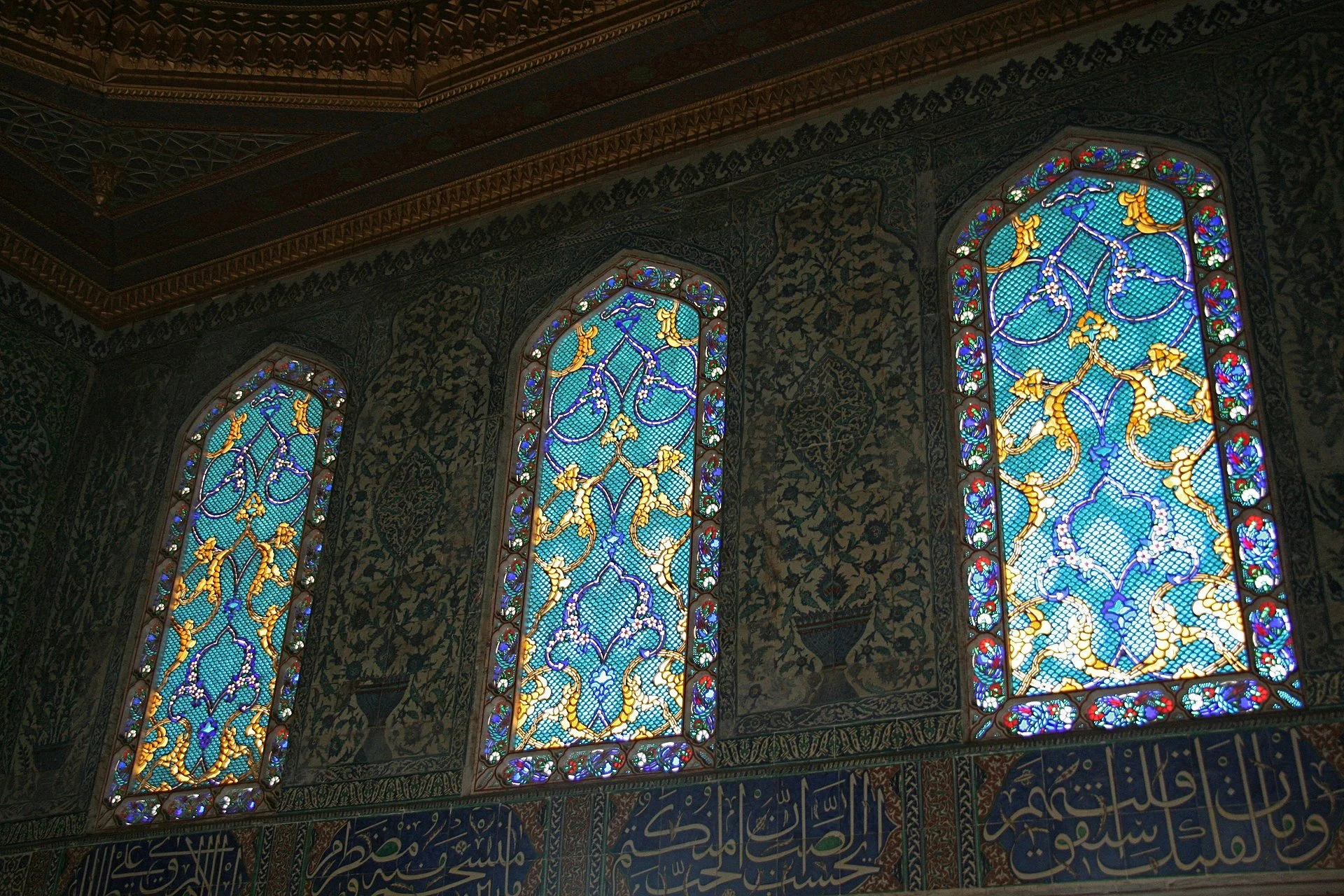
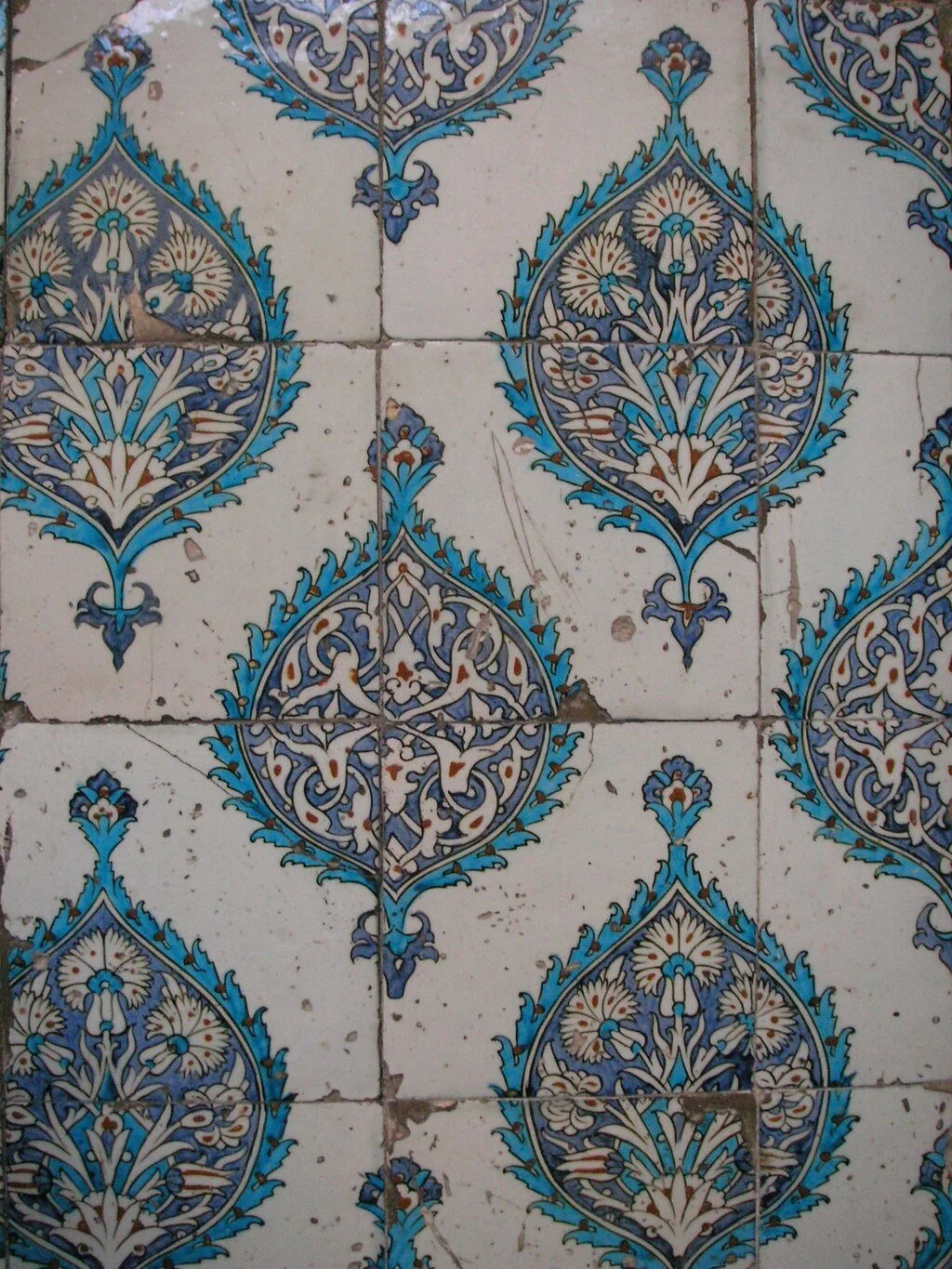
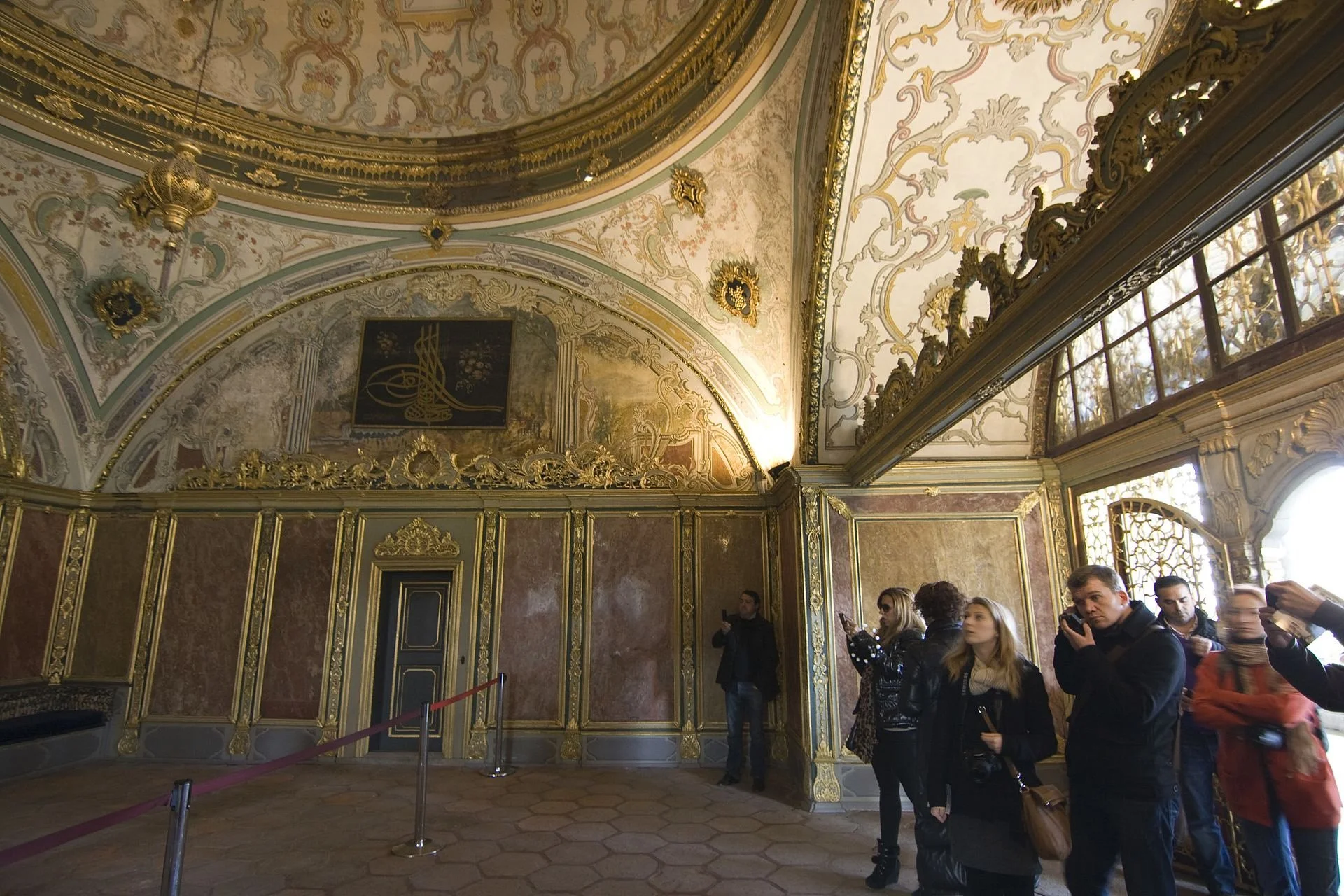
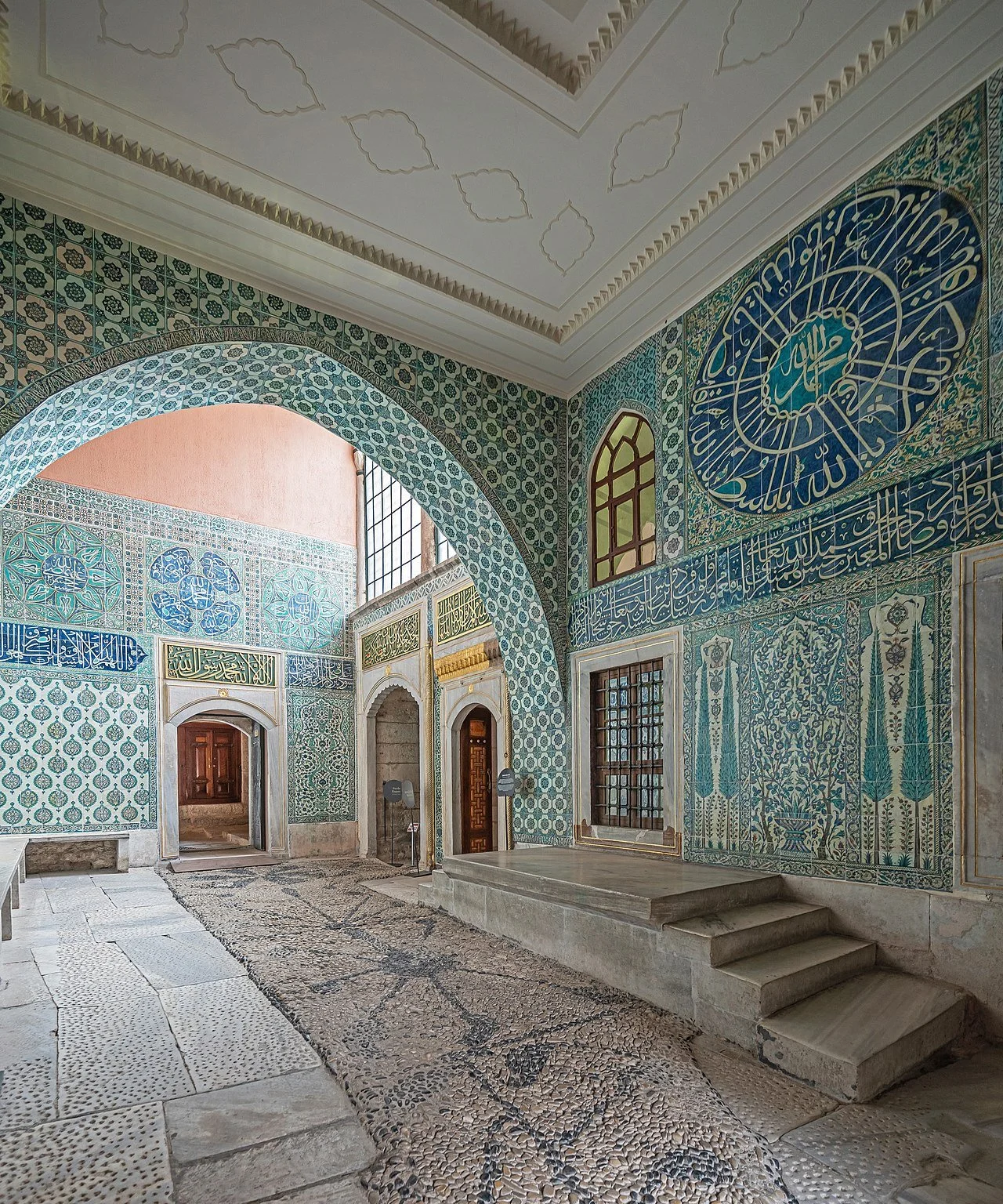
There are multiple entrances to the council hall, both from inside the palace and from the courtyard. The porch consists of multiple marble and porphyry pillars, with an ornate green and white-coloured wooden ceiling decorated with gold. The exterior entrances into the hall are in the rococo style, with gilded grills to admit natural light. While the pillars are an earlier Ottoman style, the wall paintings and decorations are from the later rococo period. Inside, the Imperial Council building consists of three adjoining main rooms. The 15th century Divanhane, built with a wooden portico at the corner of the Divan Court, was later used as the mosque of the council. There are three domed chambers: the first chamber where the Imperial Council held its deliberations is called the Kubbealtı, the second was occupied by the secretarial staff of the Imperial Council, and the third—called Defterhāne—is where the head clerks kept records of the council meetings. The main chamber Kubbealtı is, however, decorated with Ottoman Kütahya tiles.
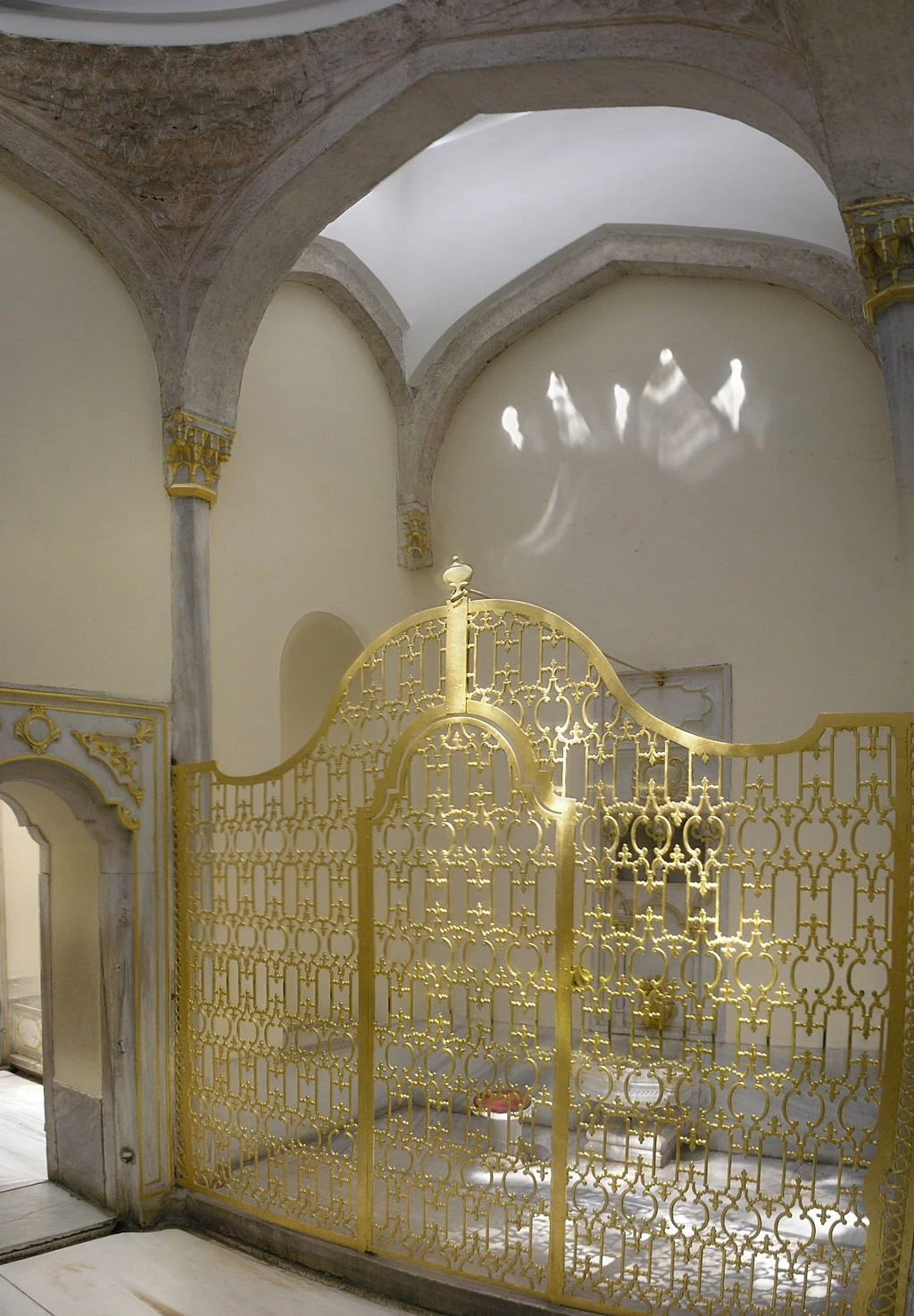
The Sultan or the Valide sultan was able to follow deliberations of the council without being noticed from a window with a golden grill. The window could be reached from the imperial quarters in the adjacent Tower of Justice (Adalet Kulesi). The window is mentioned for the first time in 1527 by the scholar Celalzade Mustafa Çelebi: "His Majesty [...] had built a high throne and a lofty loggia above the outer Council Hall where viziers sat, inventing a veiled window overlooking the Council Hall below. From this window, his Noble Excellency sometimes watched the events of the divan, checking the truth of affairs." The Tower of Justice (Adalet Kulesi) is located between the Imperial Council and the Harem.
The Tower of Justice is several stories high and the tallest structure in the palace, making it clearly visible from the Bosphorus as a landmark. The tower was probably originally constructed under Mehmed II and then renovated and enlarged by Suleiman I between 1527 and 1529. Sultan Mahmud II rebuilt the lantern of the tower in 1825 while retaining the Ottoman base. The tall windows with engaged columns and the Renaissance pediments evoke the Palladian style.
Imperial Treasury
The building where the arms and armor are exhibited was originally one of the palace treasuries (Dîvân-ı Hümâyûn Hazinesi / Hazine-ı Âmire). Since there was another ("inner") treasury in the Third Courtyard, this one was also called "outer treasury" (dış hazine). Although it contains no dated inscriptions, its construction technique and plan suggest that it was built at the end of the 15th century during the reign of Süleiman I. It subsequently underwent numerous alterations and renovations. It is a hall built of stone and brick with eight domes, each 5 x 11.40 m.
This treasury was used to finance the administration of the state. The kaftans given as presents to the viziers, ambassadors and residents of the palace by the financial department and the sultan and other valuable objects were also stored here. The janissaries were paid their quarterly wages (called ulufe) from this treasury, which was closed by the imperial seal entrusted to the grand vizier. In 1928, four years after the Topkapı Palace was converted into a museum, its collection of arms and armor was put on exhibition in this building.
During excavations in 1937 in front of this building, remains of a religious Byzantine building dating from the 5th century were found. Since it could not be identified with any of the churches known to have been built on the palace site, it is now known as "the Basilica of the Topkapı Palace" or simply Palace Basilica. Also located outside the treasury building is a target stone (Nişan Taşı), which is over two metres tall. This stone was erected in commemoration of a record rifle shot by Selim III in 1790. It was brought to the palace from Levend in the 1930s.
Arms collection
The arms collection (Silah Seksiyonu Sergi Salonu), which consists primarily of weapons that remained in the palace at the time of its conversion, is one of the richest assemblages of Islamic arms in the world, with examples spanning 1,300 years from the 7th to the 20th centuries. The palace's collection of arms and armor consists of objects manufactured by the Ottomans themselves, or gathered from foreign conquests, or given as presents. Ottoman weapons form the bulk of the collection, but it also includes examples of Umayyad and Abbasid swords, as well as Mamluk and Persian armor, helmets, swords and axes. A lesser number of European and Asian arms make up the remainder of the collection. Currently on exhibition are some 400 weapons, most of which bear inscriptions.
Gate of Felicity
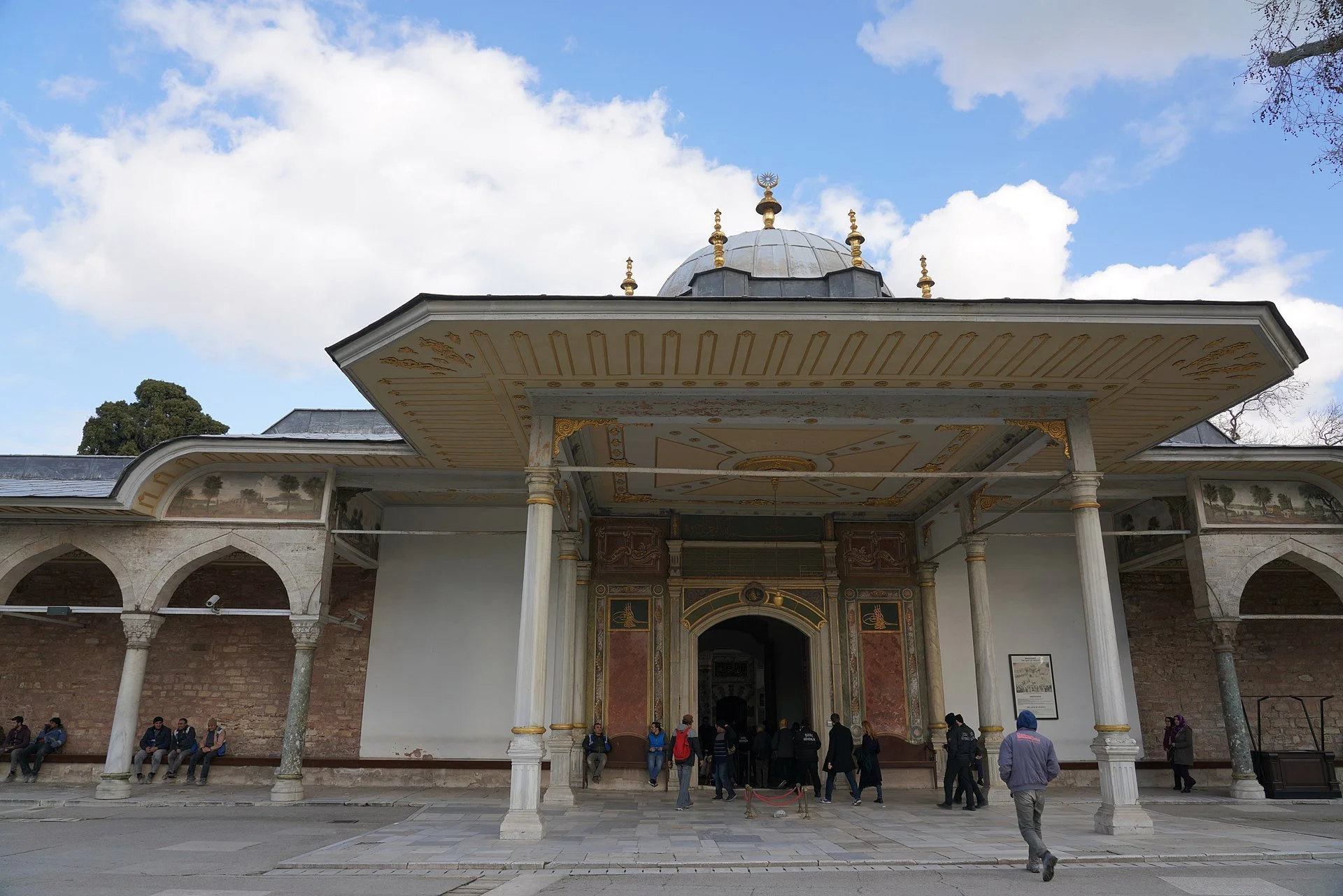
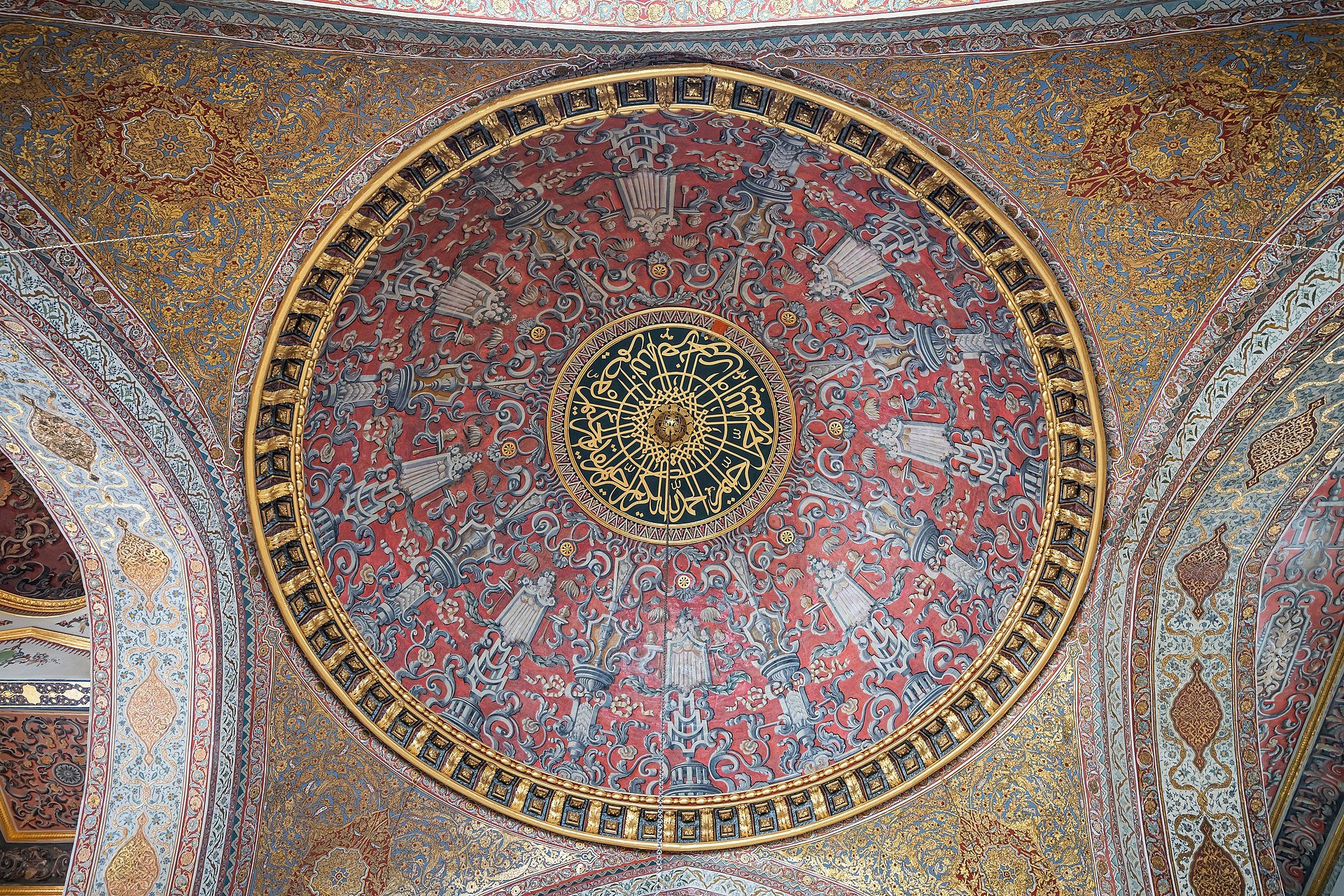
The Gate of Felicity (Bâbüssaâde or Bab-üs Saadet) is the entrance into the Inner Court (Enderûn meaning "inside" in Persian), also known as the Third Courtyard, marking the border to the Outer Court or Birûn (meaning "outside" in Persian). The Third Courtyard comprises the private and residential areas of the palace. The gate has a dome supported by lean marble pillars. It represents the presence of the Sultan in the palace. No one could pass this gate without the authority of the Sultan. Even the Grand Vizier was only granted authorisation on specified days and under specified conditions. The gate was probably constructed under Mehmed II in the 15th century. It was redecorated in the rococo style in 1774 under Sultan Mustafa III and during the reign of Mahmud II. The gate is further decorated with Qur'anic verses above the entrance and tuğras. The ceiling is partly painted and gold-leafed, with a golden ball hanging from the middle. The sides with baroque decorative elements and miniature paintings of landscapes.
The Sultan used this gate and the Divan Meydanı square only for special ceremonies. The Sultan sat before the gate on his Bayram throne on religious, festive days and accession, when the subjects and officials perform their homage standing. The funerals of the Sultan were also conducted in front of the gate. On either side of this colonnaded passage, under control of the Chief Eunuch of the Sultan's Harem (called the Bâbüssaâde Ağası) and the staff under him, were the quarters of the eunuchs as well as the small and large rooms of the palace school. The small, indented stone on the ground in front of the gate marks the place where the banner of Muhammad was unfurled. The Grand Vizier or the commander going to war was entrusted with this banner in a solemn ceremony.
Audience Chamber
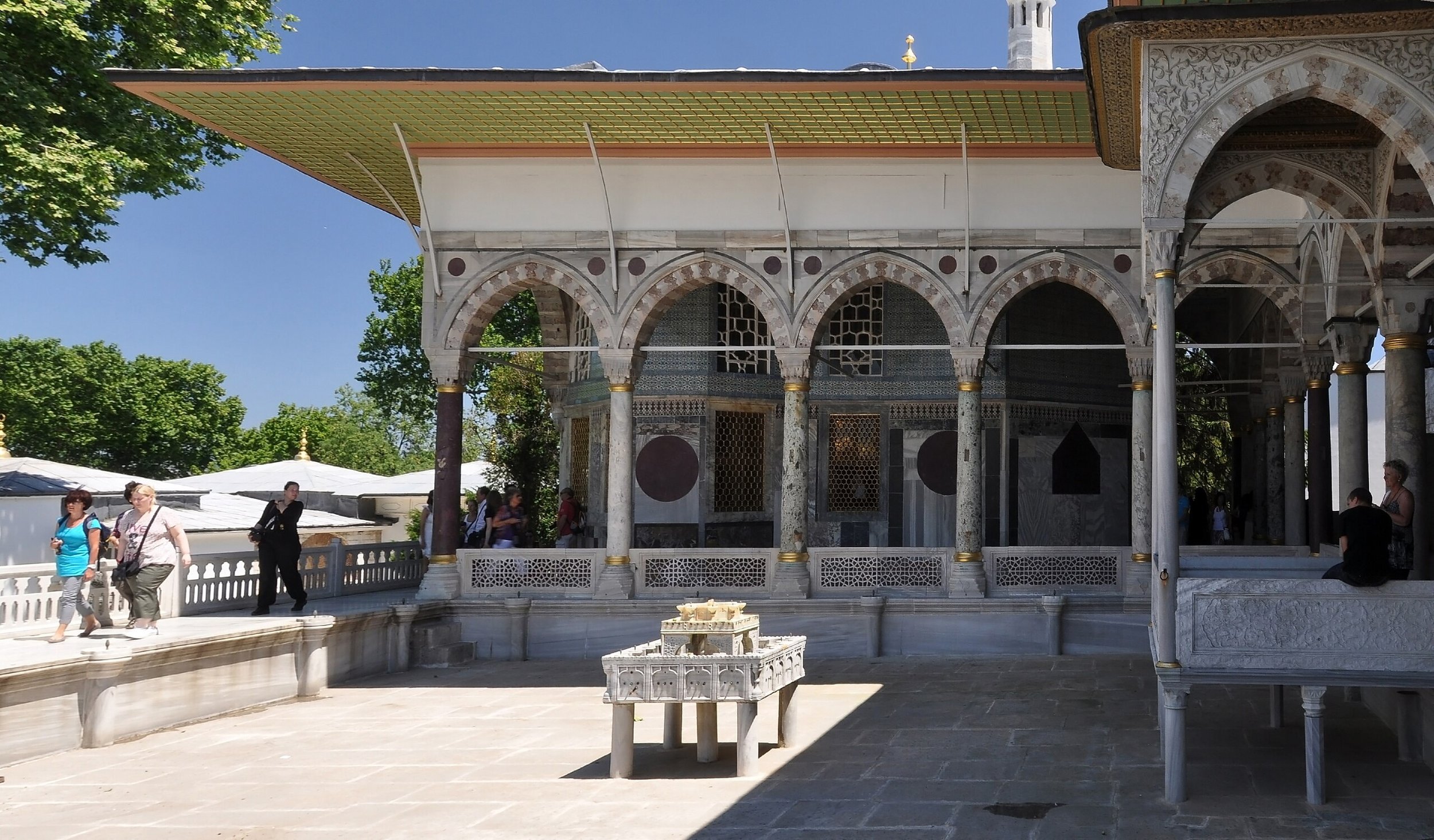
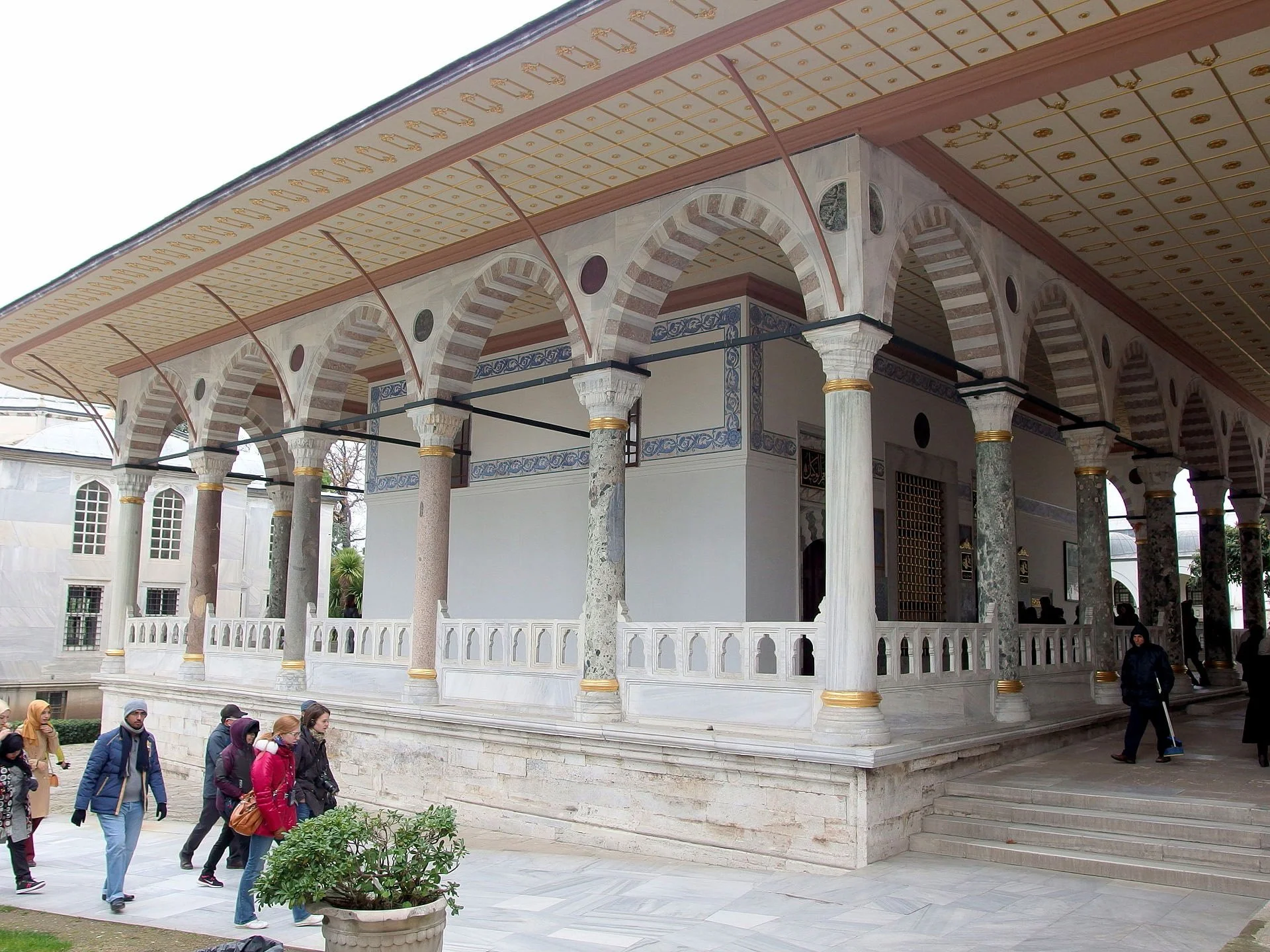
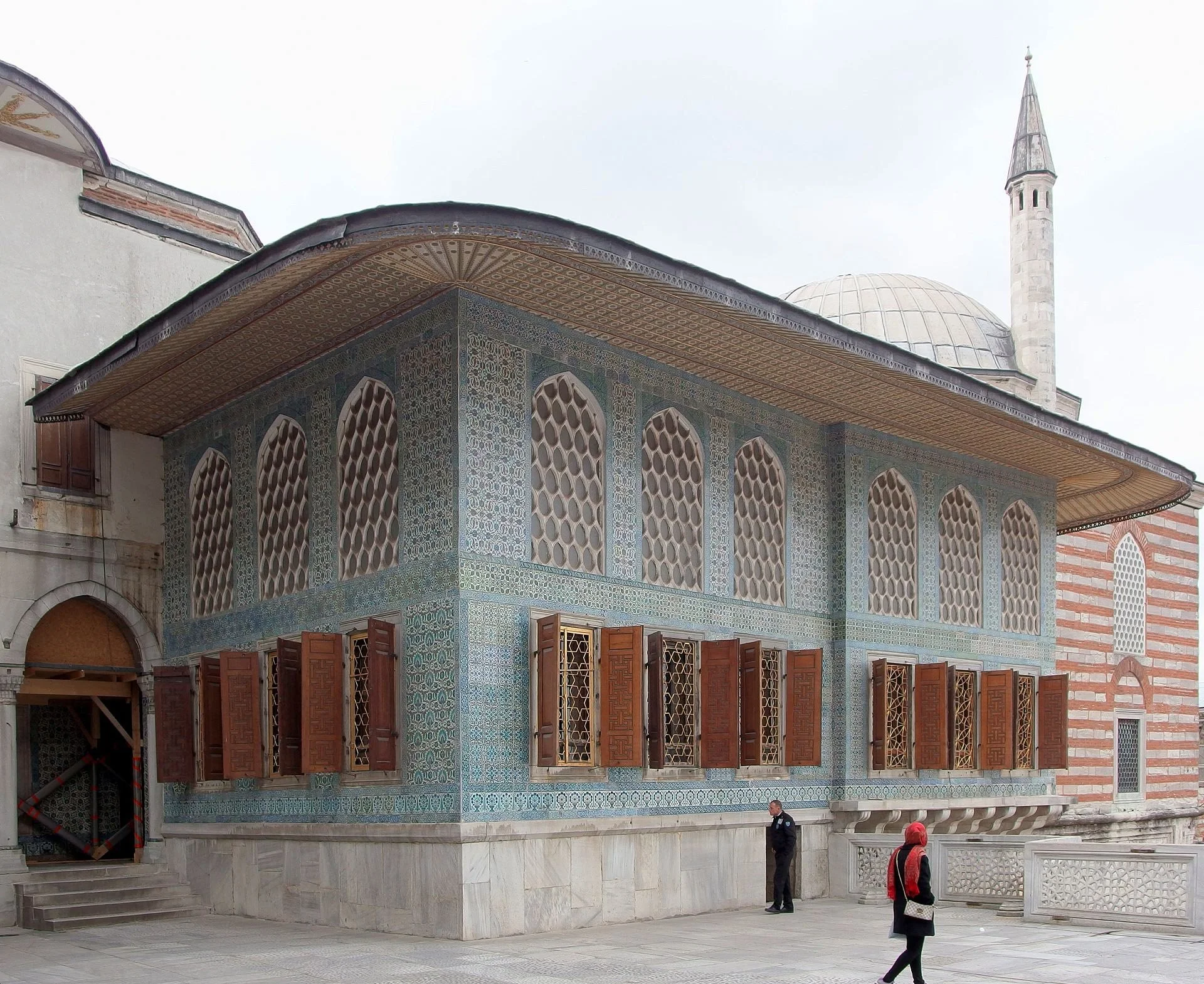
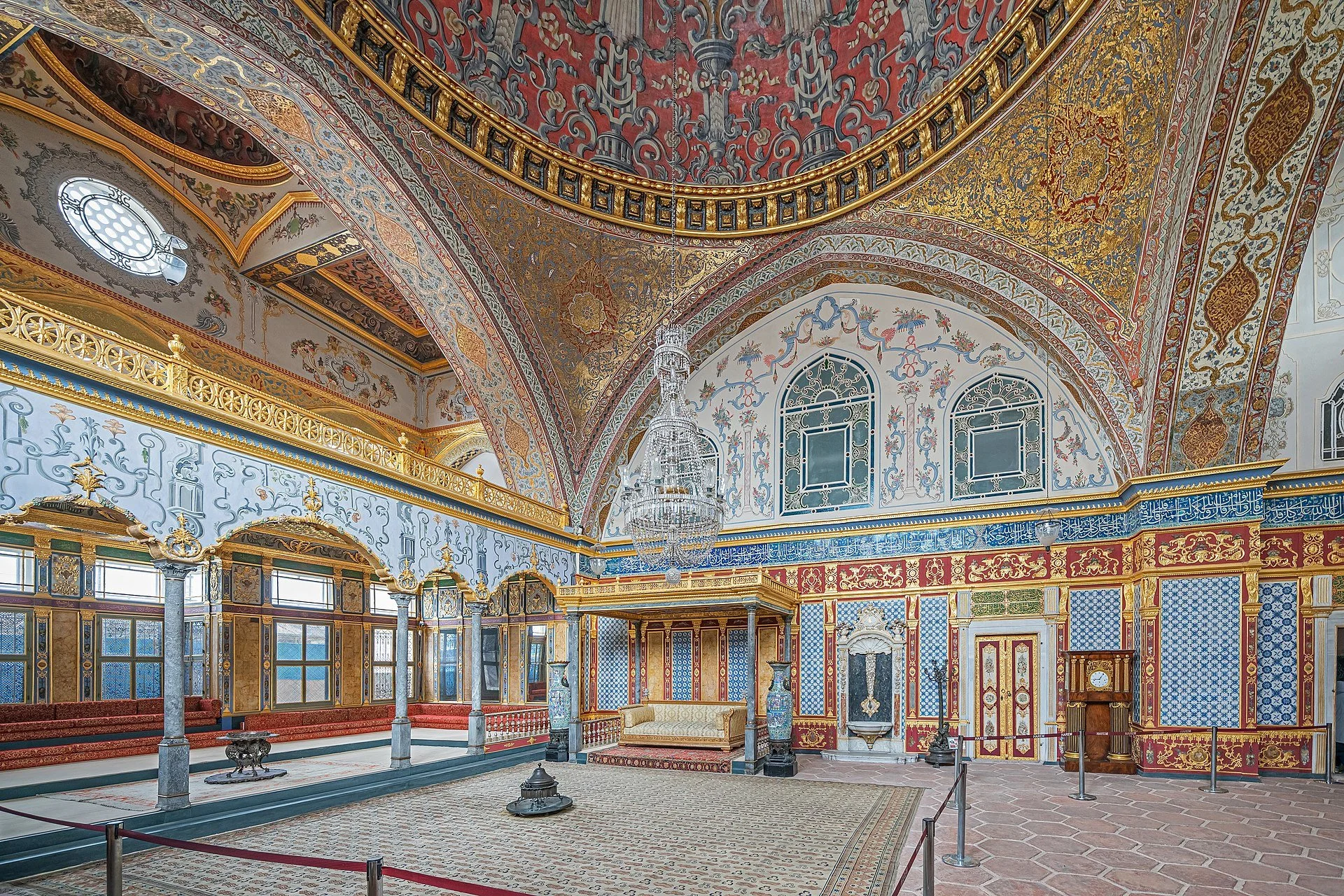
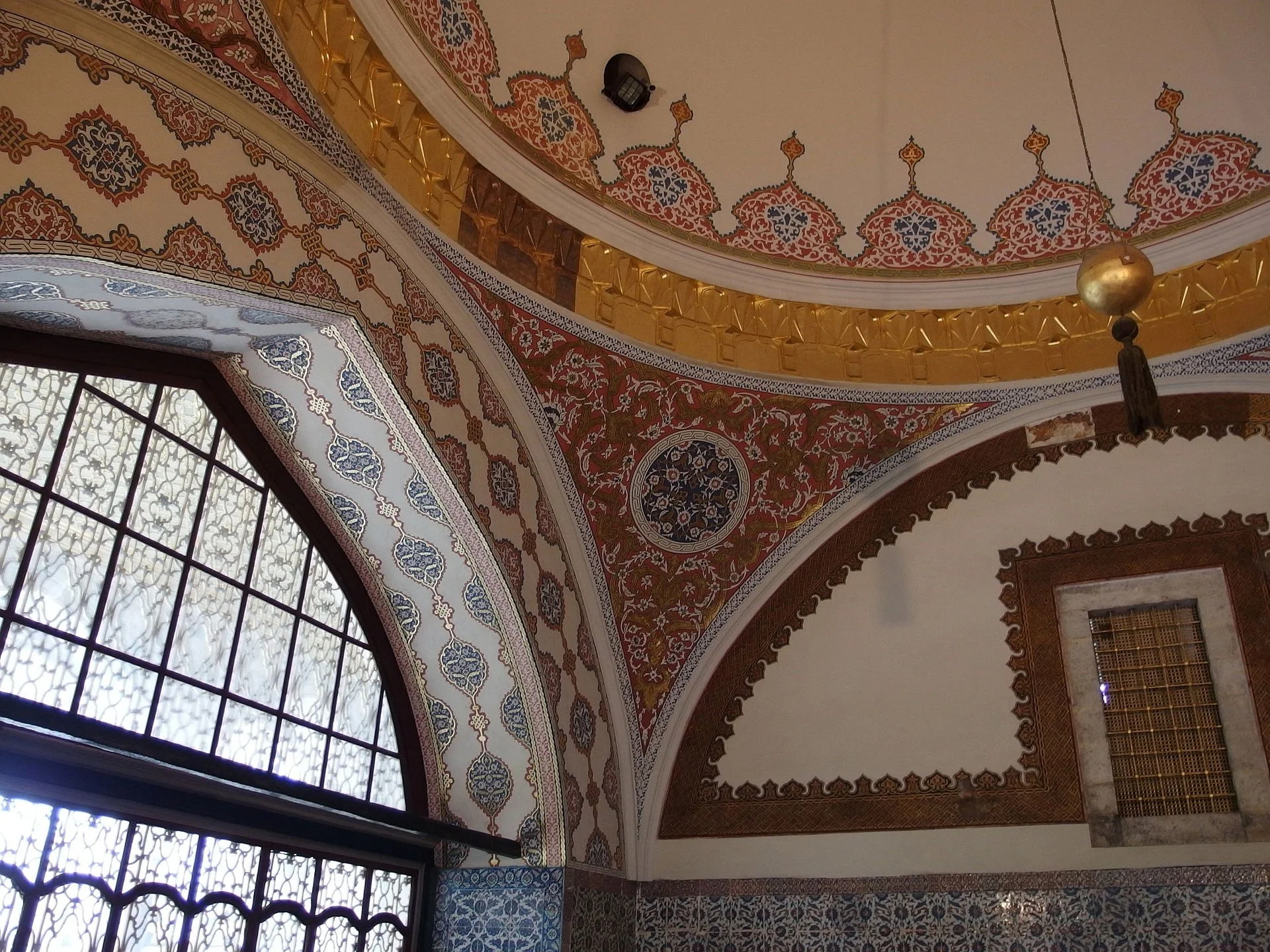
The Audience Chamber, also known as the Chamber of Petitions (Arz Odası), is right behind the Gate of Felicity. This square building is an Ottoman kiosk, surrounded by a colonnade of 22 columns supporting the large roof with hanging eaves. The building dates from the 15th century. The ceiling of the chamber was painted in ultramarine blue and studded with golden stars. The walls were lined with blue, white and turquoise tiles. The chamber was further decorated with precious carpets and pillows. The chamber was renovated in 1723 by Sultan Ahmed III. It was destroyed in the fire of 1856 and rebuilt during the reign of Abdülmecid I.
The main throne room is located inside the audience chamber. According to a contemporary account by envoy Cornelius Duplicius de Schepper in 1533: "The Emperor was seated on a slightly elevated throne completely covered with gold cloth, replete and strewn with numerous precious stones, and there were on all sides many cushions of inestimable value; the walls of the chamber were covered with mosaic works spangled with azure and gold; the exterior of the fireplace of this chamber of solid silver and covered with gold, and at one side of the chamber from a fountain water gushed forth from a wall." The present throne in the form of a baldachin was made on the order of Mehmed III. On the lacquered ceiling of the throne, studded with jewels, are foliage patterns accompanied by the depiction of the fight of a dragon, symbol of power, with simurg, a mythical bird. On the throne there is a cover made of several pieces of brocade on which emerald and ruby plaques and pearls are sown.
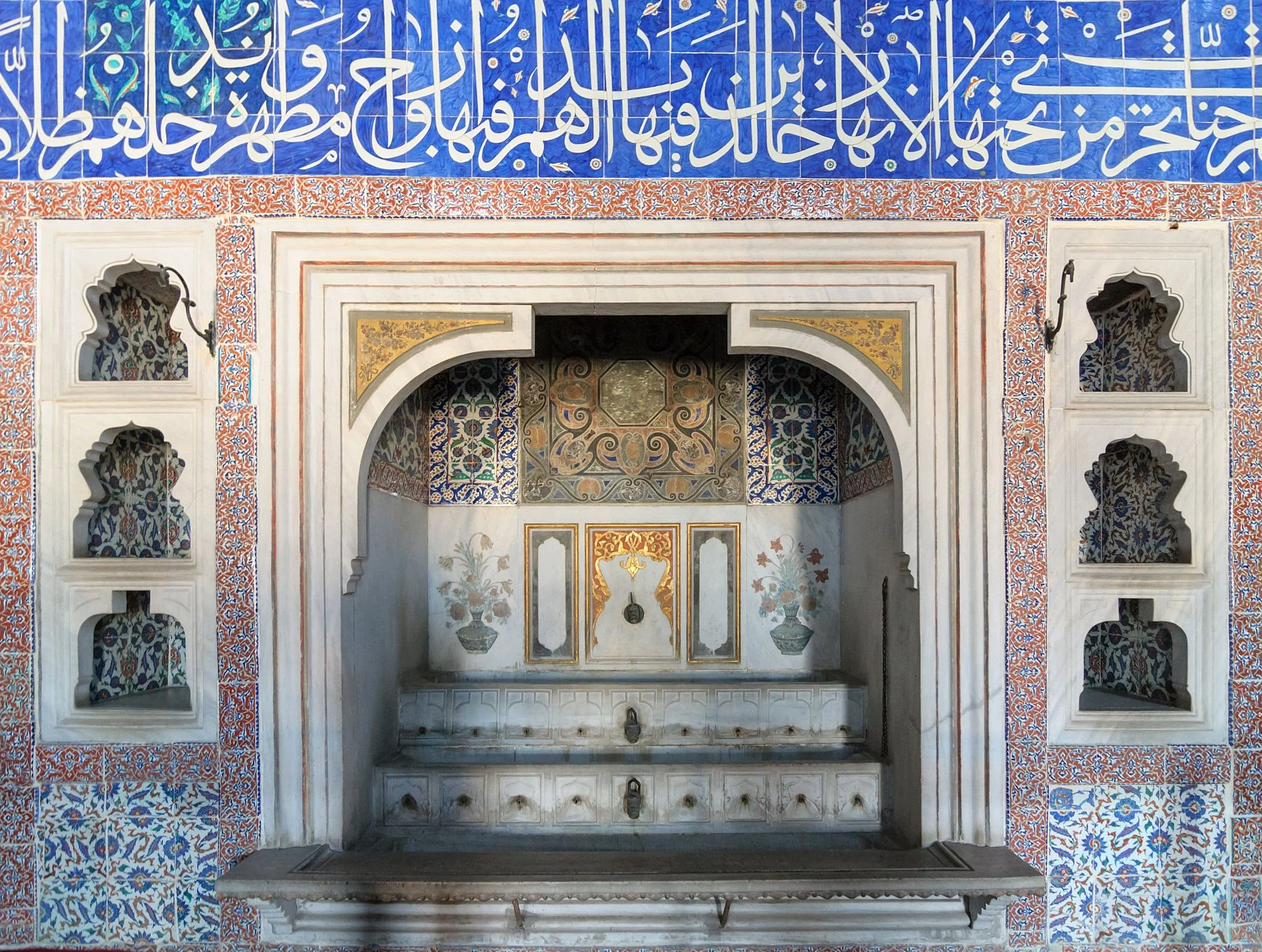
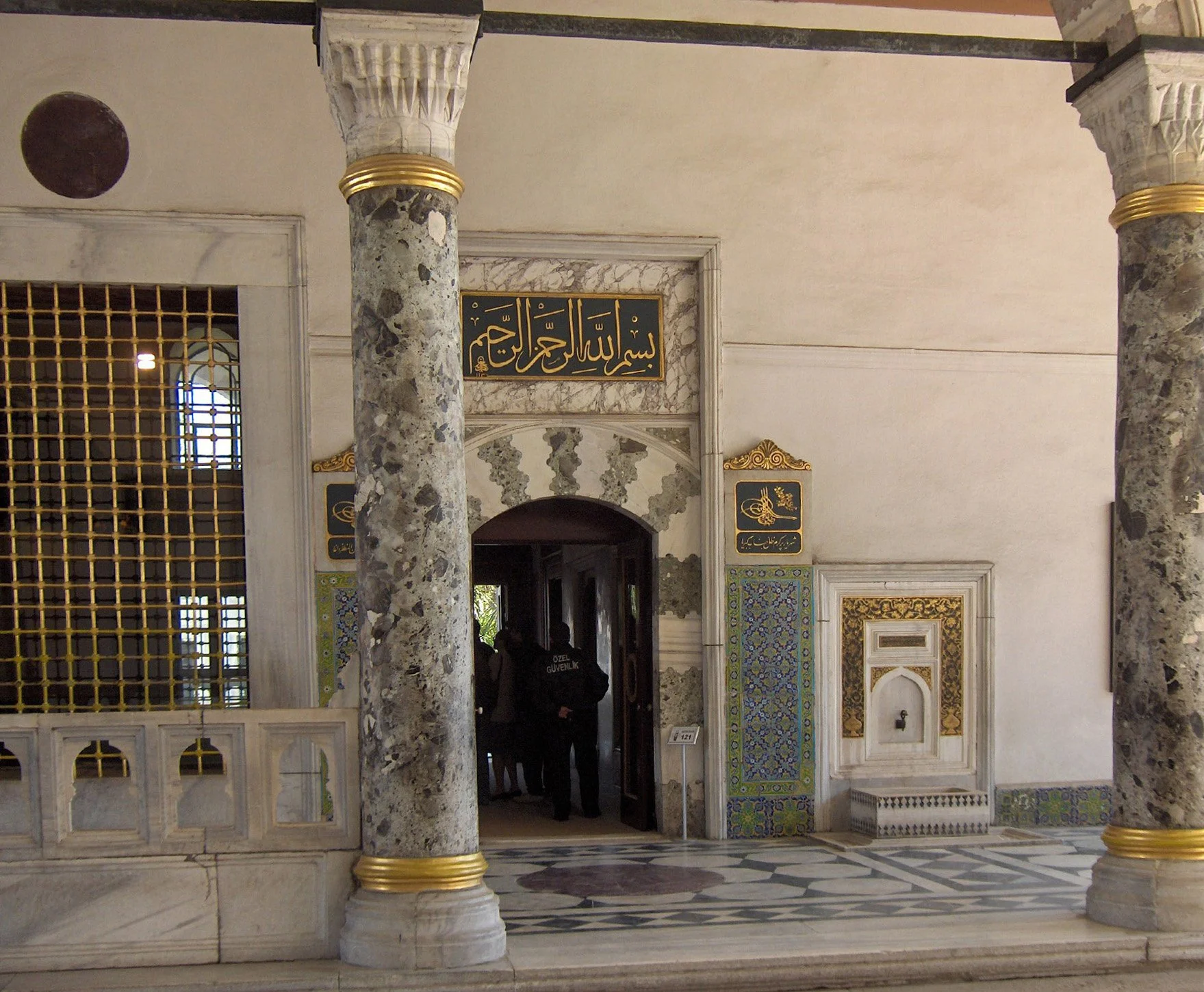
Embossed inscriptions at the main visitors' door, dating from 1856, contain laudatory words for Sultan Abdülmecid I. The main door is surmounted by an embossed besmele, the common Muslim benediction, meaning "In the Name of God the Compassionate, the Merciful", dating from 1723. This inscription was added during the reign of Sultan Ahmed III. The tile panels on either side of the door were placed during later repair work. There is a small fountain by the entrance from the time of Suleiman I. The Persian inscriptions calls the sultan "the fountainhead of generosity, justice and the sea of beneficence." Gifts presented by ambassadors were placed in front of the large window in the middle of the main facade between the two doors. The Pişkeş Gate to the left (Pişkeş Kapısı, Pişkeş meaning gift brought to a superior) is surmounted by an inscription from the reign of Mahmud II, which dates from 1810. Behind the Audience Chamber on the eastern side is the Dormitory of the Expeditionary Force (Seferli Koğuşu), which houses the Imperial Wardrobe Collection (Padişhah Elbiseleri Koleksiyonu). This collection is made up of around 2,500 garments, including the precious kaftans of the Sultans. It also houses a collection of 360 ceramic objects. The dormitory was constructed under Sultan Murad IV in 1635. The building was restored by Sultan Ahmed III in the early 18th century. The dormitory is vaulted and is supported by 14 columns. Adjacent to the dormitory, located northeast, is the Conqueror's Pavilion, which houses the Imperial Treasury.
The Imperial Treasury
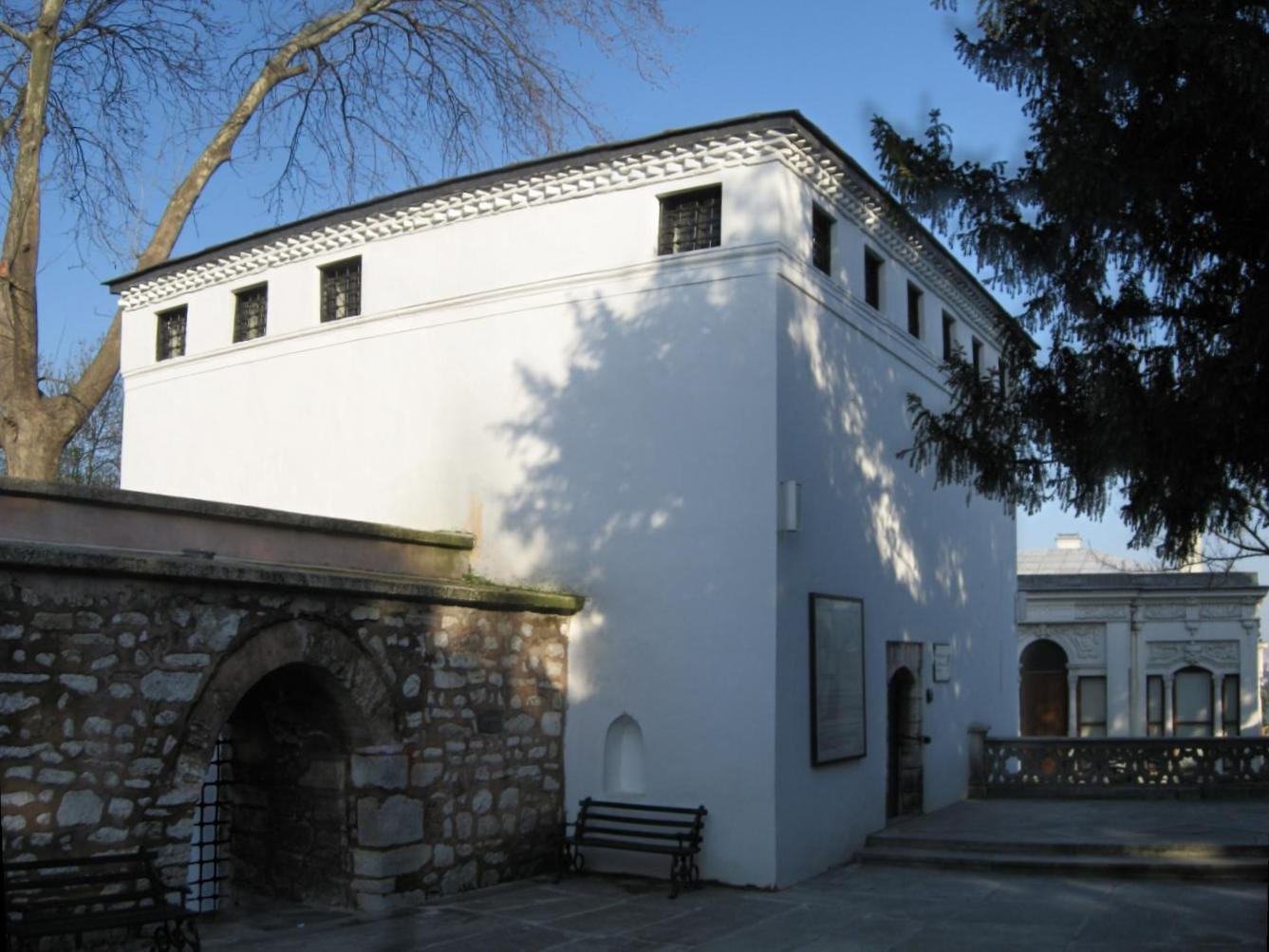
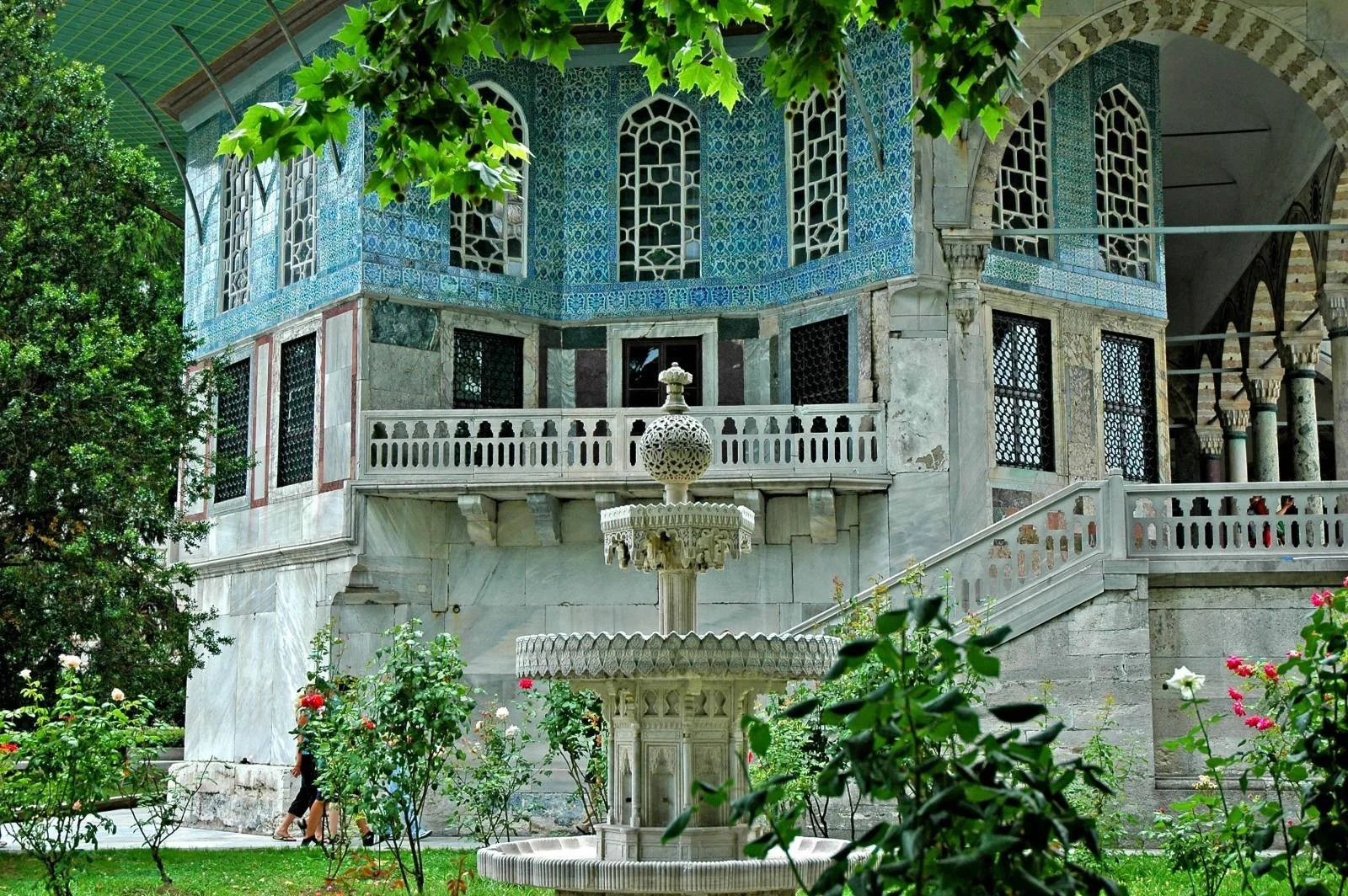
The Conqueror's Pavilion, also called the Conqueror's Kiosk (Fatih Köşkü) is one of the oldest buildings inside the palace. It was built c. 1460, when the palace was first constructed. It consists of two floors raised on a terrace above the garden, built at the top of the promontory on a cliff with views from its porch of the Sea of Marmara and the Bosporus. The lower floor consisted of service rooms, while the upper floor was a suite of four apartments and a large loggia with double arches. All the rooms open onto the Third Courtyard through a monumental arcade. The colonnaded portico on the side of the garden is connected to each of the four halls by a large door. The pavilion was used as the treasury for the revenues from Egypt under Sultan Selim I. During excavations in the basement, a small Byzantine baptistery built along a trefoil plan was found. It houses the Imperial Treasury (Hazine-i Âmire).
The Imperial Treasury is a vast collection of artworks, jewelry, heirlooms and money belonging to the Ottoman dynasty. The Chief Treasurer (Hazinedarbaşı) was responsible for the Imperial Treasury. The first room of the treasury houses one of the armours of Sultan Mustafa III, consisting of an iron coat of mail decorated with gold and encrusted with jewels. His gilded sword, shield and stirrups are also on display. The ebony throne of Murad IV, inlaid with nacre and ivory may also be found in this room. Other pieces include several pearl embellished Qur'an covers belonging to the sultans and jewel-encrusted looking glasses. There is a music box from India with a gold elephant dating from the 19th century.
The second room houses the Topkapı Dagger. The golden hilt is ornamented with three large emeralds, topped by a golden watch with an emerald lid. The golden scabbard is covered with diamonds and enamel. In 1747, the Sultan Mahmud I had this dagger made for Nader Shah of Persia, but the Shah was assassinated in connection with a revolt before the emissary had left the Ottoman Empire's boundaries. This dagger gained more fame as the object of the heist depicted of the film Topkapi. In the middle of the second room stands the walnut throne of Ahmed I, inlaid with nacre and tortoise shell, built by Sedekhar Mehmed Agha. Below the baldachin hangs a golden pendant with a large emerald. The next displays show the ostentatious aigrettes of the sultans and their horses, studded with diamonds, emeralds and rubies. A jade bowl, shaped like a vessel, was a present of Czar Nicholas II of Russia.
The most eye-catching jewel in the third room is the Spoonmaker's Diamond, set in silver and surrounded in two ranks with 49 cut diamonds. Legend has it that this diamond was bought by a vizier in a bazaar, the owner thinking it was a worthless piece of crystal. Another, perhaps more likely history for the gem places it among the possessions of Tepedeleni Ali Pasha, confiscated by the Sultan after his execution. Still more fanciful and romantic versions link the diamond's origins with Napoleon Bonaparte's mother Letizia Ramolino.
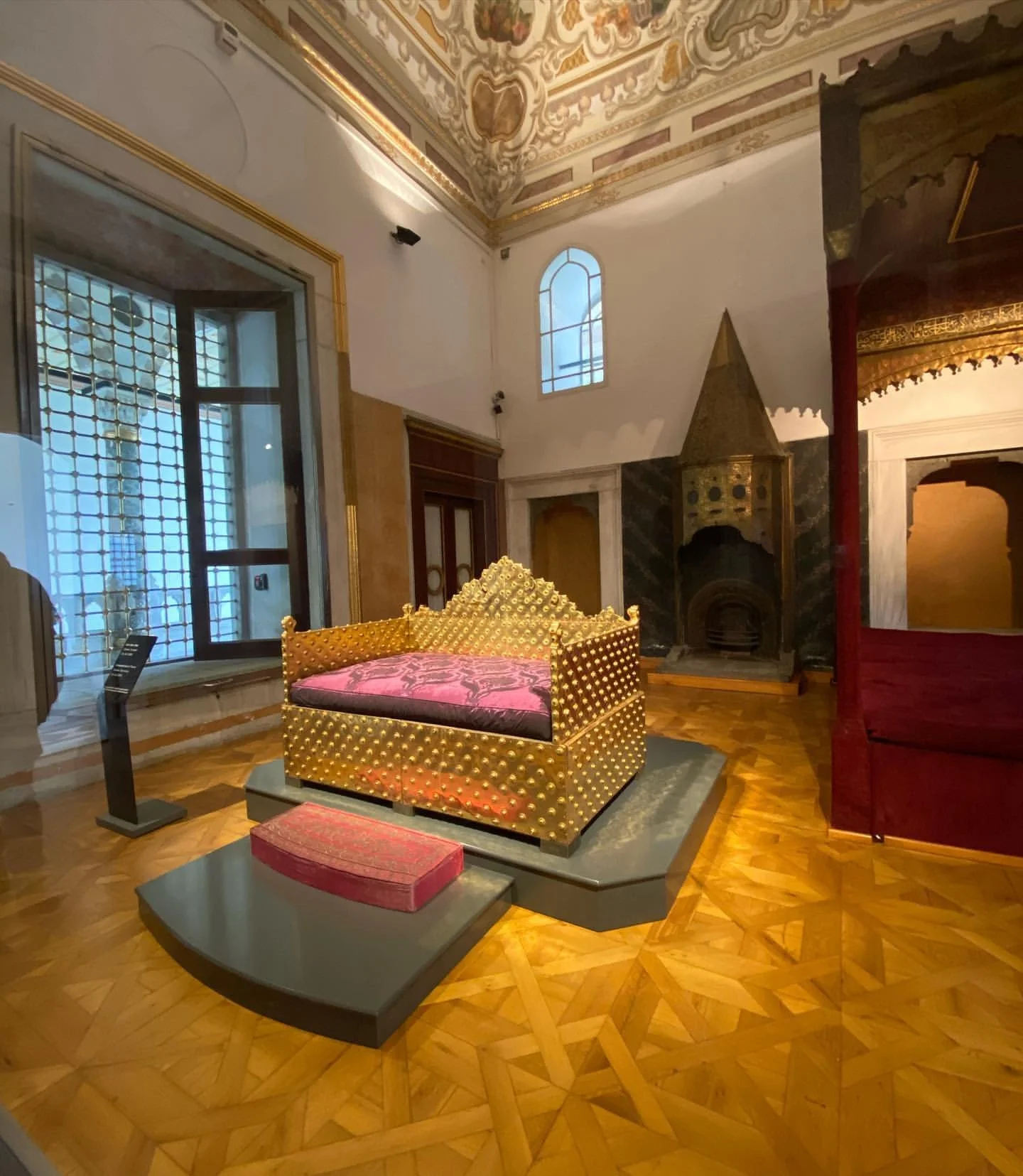
Among the exhibits are two enormous solid gold candleholders, each weighing 48 kg and mounted with 6,666 cut diamonds, a present of Sultan Abdülmecid I to the Kaaba in the holy city of Mecca. They were brought back to Istanbul shortly before the Ottoman Empire lost control over Mecca. The gold ceremonial Bayram throne, mounted with tourmalines, was made in 1585 by order of the vizier Ibrahim Pasha and presented to Sultan Murad III. This throne would be set up in front of the Gate of Felicity on special audiences.
The throne of Sultan Mahmud I is the centerpiece of the fourth room. This gold-plated throne in Indian style, decorated with pearls and emeralds, was a gift of the Persian ruler Nader Shah in the 18th century. Another exhibit shows the forearm and the hand of St. John the Baptist (Yahya), set in a golden covering. Several displays show an assembly of flintlock guns, swords, spoons, all decorated with gold and jewels. Of special interest is the gold shrine that used to contain the cloak of Mohammed.

Related Curated Collections: Relaxed Contemporary
Living Room
Dining Room
Bedroom
Topkapi Palace Museum
The copyright of photographs of inspiring places are held by the authors of the photographs or are within the public domain. By presenting these images, our intention is to showcase the extraordinary spaces that they capture, increase awareness of these homes, and encourage visitors to purchase tickets and visit them in-person. As is the case with the source of these images, they are offered free of charge and accessible to anyone who searches for the specific inspiring place. In order to streamline the virtual experience of these homes, we have not highlighted attribution. If you are the author of any photograph and would like specific attribution or us to create a link to the original photograph or your business or body of photographic work, please contact us at info@ourthings.io and we would be more than happy to accommodate your request. If you would not like your work to be featured, we would also be happy to remove the image. Images credits for this inspiring home include: N/A.
