
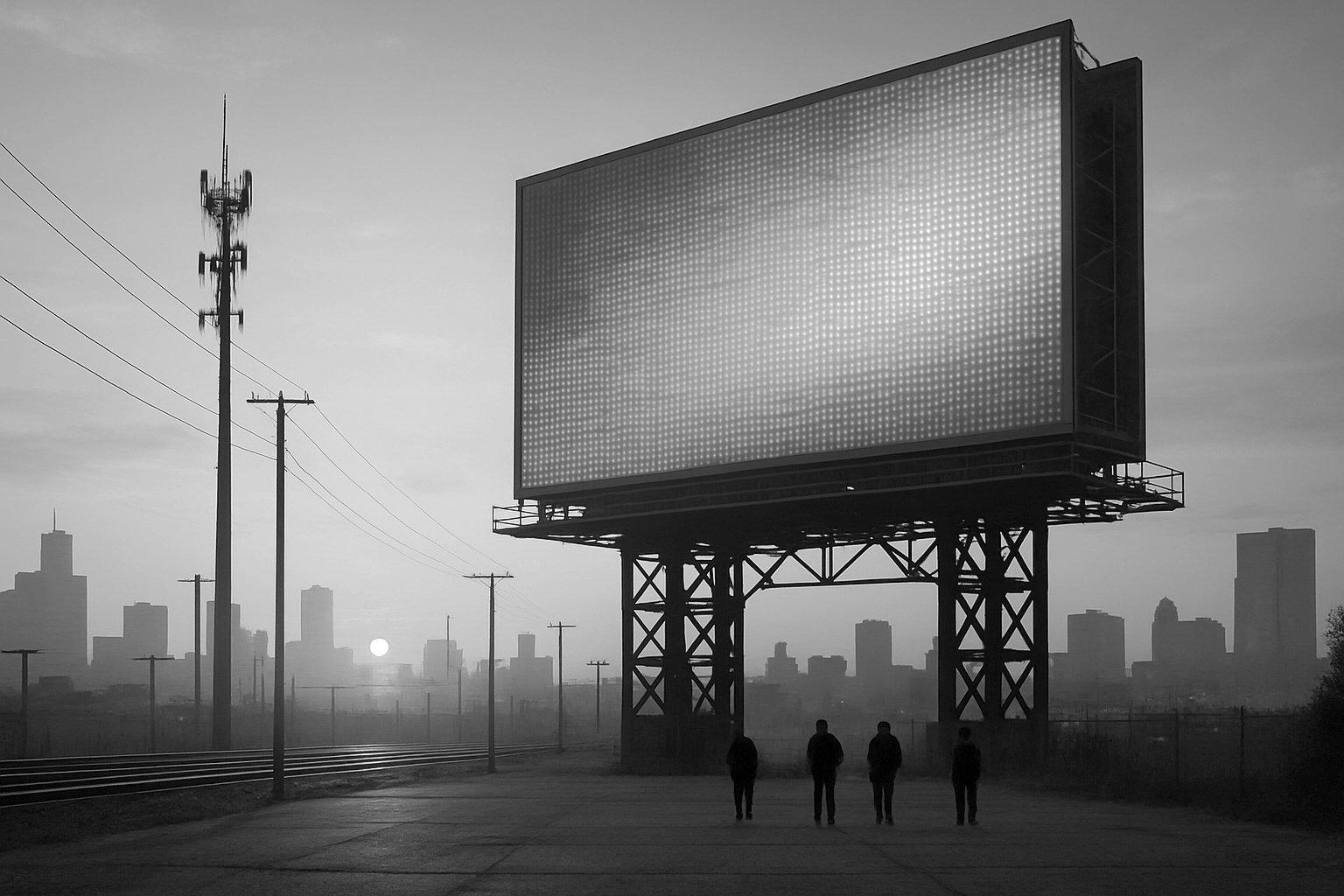

The Political Economy of Cultural Entities
The Political Economy of Cultural Entities examines the construction, circulation, and economic logic of images as instruments of political argument. Rather than tracing the long lineage of iconography or representation, this inquiry focuses on how the postmodern image is built and mobilized within a field cleared by abstraction and the broader critique of representation. The contemporary image—formed within the lens of the camera, the frame of the screen, and the immersive field of virtual and augmented realities—retains the memory of art history and collective visual culture even as it becomes fluid, temporal, and networked. It is no longer static but animated by the systems that produce and disseminate it: platforms, devices, production infrastructures, and the distributed networks of human and algorithmic agents that shape its life. Such images possess agency—they can influence events, reframe public opinion, and alter the conditions of the physical world. Their production depends on intricate apparatuses and talent networks that merge creative labor with technological and economic systems. In this sense, the image functions both as a product of political economy and as an actor within it: a constructed world that extends the logic of conceptual art and cultural production into realms capable of reorganizing social relations, spatial environments, and collective belief.
Research and White Papers
-
This paper examines the infrastructures—technical, institutional, and creative—that produce the contemporary image. It explores the “unity economics” of these apparatuses: how they organize relationships between producers and consumers, and how control over them shapes political intent and media power. By tracing ownership, authorship, and access, it considers how the means of image production define cultural sovereignty and political possibility.
-
Here, the focus shifts from production to distribution: the networks that circulate images, amplify them, and determine who sees what, when, and why. The paper explores the economic, algorithmic, and geopolitical mechanisms that give images reach and rhythm in a globalized media ecology. It reveals how circulation itself becomes a form of power—governing attention, value, and belief.
-
This study investigates the productive tension between the gestalt of the image—its promise of total representation—and the excess of lived experience that continually escapes it. By examining moments when the image fails to contain reality, it reveals how breakdowns in representation generate new standpoints, emotional intensities, and calls for political or aesthetic action. The inadequacy of the image becomes a source of renewal, critique, and resistance.
-
This paper explores the frontier of image-making as a site of both technical innovation and ideological struggle. It examines how conceptual and speculative art practices engage production systems—from immersive simulation to computational rendering—as forms of political intervention. By reimagining production itself as a critical practice, it redefines the frontier as both a technological and ethical domain.
-
As images become increasingly manipulable in real time, this essay investigates the tools, costs, and values of such control. It considers who gains agency through the ability to edit, reshape, and deploy visual content instantly, and how this shifts the balance between participation and surveillance. The image emerges as a tactical field—simultaneously an asset, a weapon, and a site of negotiation.
-
This paper focuses on the image as event—moments in which narrative, catastrophe, or paradigm shift become visually and symbolically actualized. It analyzes how certain images crystallize collective experience, producing turning points in politics, media, and consciousness. The event-image functions as both representation and rupture, condensing meaning into an immediate and transformative encounter.
-
This study traces how narrative now enters and animates the image. It explores how contemporary apparatuses—cinema, platforms, immersive installations, and extended reality—transform story into material experience. The paper situates narrative as both aesthetic device and political instrument, revealing how images are now executed rather than merely shown.
-
The final paper examines how images mobilize desire through mechanisms of touch, exclusion, and the body. It investigates the erotic, affective, and sensory economies that underpin visual culture, and how these energies are harnessed to sustain attention and consumption. By mapping the relationship between desire, prohibition, and access, it exposes the image as both a site of longing and a system of control.

Call to Action
The political agency of the culture industry is no longer an abstract question—it is a structural reality shaping economies, publics, and the spaces where knowledge and belief are formed. We invite artists, theorists, technologists, curators, producers, and institutional leaders to collaborate in a shared investigation of the apparatuses that construct and circulate the image today. Together, we can map the economic and technical systems that underwrite representation, examine how power operates through them, and design new forms of cultural production that expand autonomy rather than diminish it. This is an open call to rethink the relationship between image, infrastructure, and political life—and to build the frameworks that will define the next era of cultural agency.